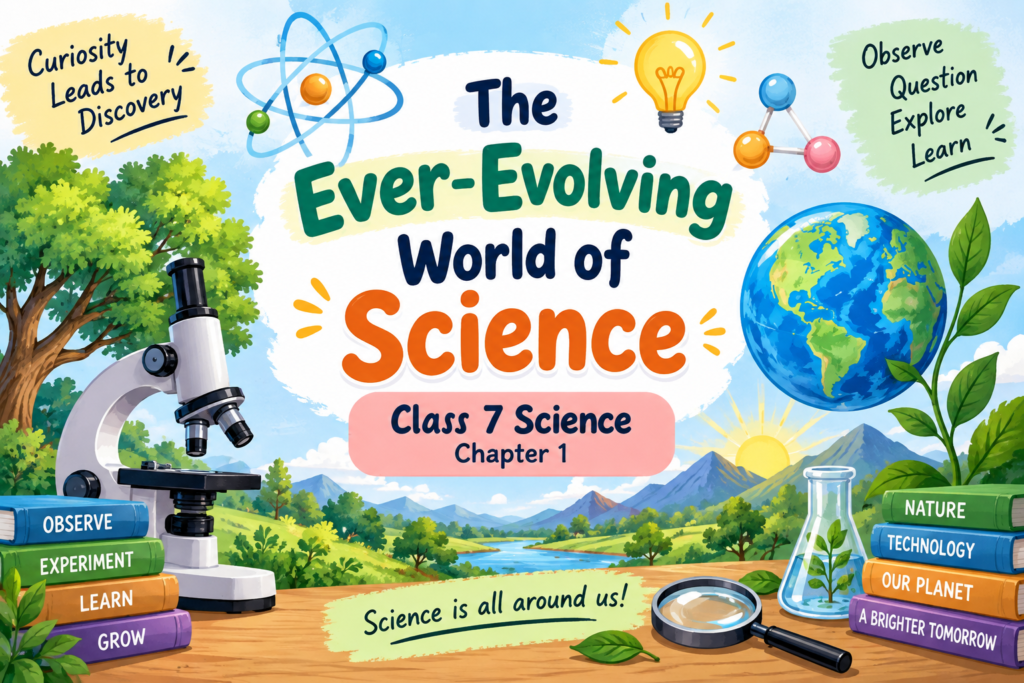
Have you ever wondered why a mango tastes sour before it becomes sweet? why a wet school uniform dries in the sun? why a turmeric stain changes colour when washed with soap? or why we see our shadow only when there is light?
Introduction
Science is not just a subject in your timetable. It is a way of understanding the world around us. The moment we ask, “Why does this happen?”, we begin to think like scientists.
Science helps us understand the world around us. It explains natural events, helps us develop useful technologies, improves healthcare and communication, and gives us better ways to solve environmental problems. As our knowledge grows, science keeps changing and improving. New discoveries often lead to better questions, better explanations and better technologies.
For Class 7, science becomes really exciting because you start connecting your everyday life to big ideas.
Table of contents
Human Activities, the Natural World and Society
Human beings are closely connected with nature. We depend on air, water, soil, plants, animals and minerals for our survival. At the same time, our activities can change natural systems.
For example, cutting large numbers of trees can reduce forest cover and affect wildlife. Burning fossil fuels releases carbon dioxide and other pollutants into the atmosphere. Using too much groundwater can lower the water level, while plastic waste can pollute land and water.
These changes also affect society. Air pollution can make breathing difficult, polluted water can spread diseases, and changes in rainfall patterns can affect agriculture.
But humans are also capable of finding solutions. Science helps us understand these problems and develop better ways of living.
Science and the Challenge of a Sustainable Future
Science plays an important role in creating a more sustainable world. Scientists study environmental changes and develop new ways to use natural resources responsibly.
Some examples are:
- Renewable energy: Solar and wind energy can produce electricity without burning fossil fuels.
- Water conservation: Methods such as drip irrigation help save water.
- Waste management: Recycling and composting help reduce waste.
- Energy-efficient devices: LED bulbs and efficient appliances help save electricity.
Science helps us understand environmental problems and find better solutions. However, scientific knowledge alone is not enough. We also need to use resources wisely and make responsible choices to protect our planet for the future.
Science alone cannot solve every environmental problem. Human choices and responsible use of technology are equally important. A sustainable future requires both scientific knowledge and responsible behaviour.
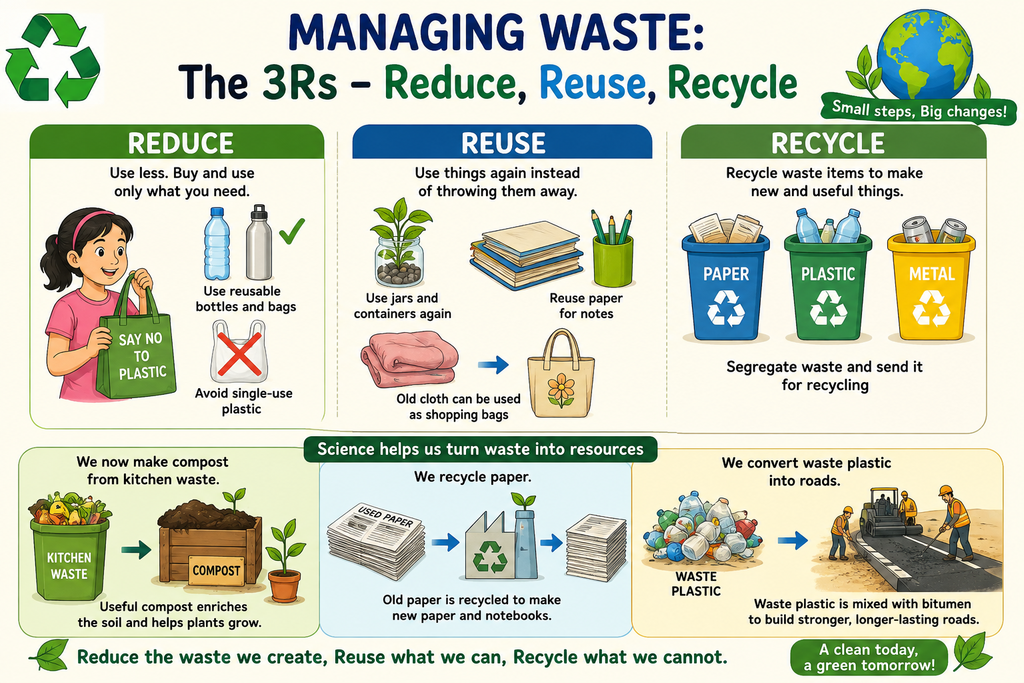
The 3Rs – Reduce, Reuse, Recycle – come from science. We now make compost from kitchen waste, recycle paper, and convert waste plastic into roads.
Properties of Materials Around Us
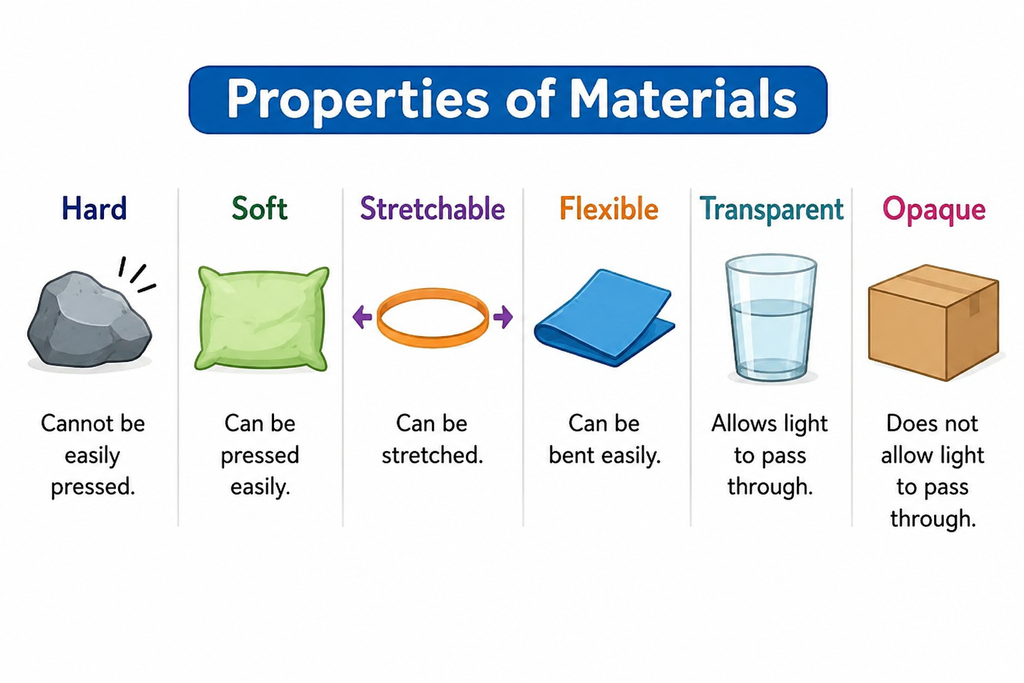
Look around you. Your desk, water bottle, notebook, pencil, clothes and windows are all made of different materials. Have you ever wondered why we use different materials to make different things?
This is because every material has certain properties that make it suitable for a particular use. For example, glass is used for windows because we can see through it, while metal is used for many tools because it is strong.
By observing and comparing different materials, we can learn why they are suitable for different uses in our everyday life.
Everyday Science: Why Does This Happen?
Why are some fruits sour?
Have you ever bitten into an unripe mango and immediately made a funny face?

Many fruits taste sour because they contain natural acids. For example, lemons contain citric acid, while tamarind contains tartaric acid. These acids give the fruits their sour taste. As some fruits ripen, their chemical composition changes. Acidity may decrease while sugars increase, making the fruit taste sweeter.
So the next time a fruit makes your face wrinkle, remember—it is science at work!
What happens when we wash a haldi stain on our school uniform?
Turmeric, or haldi, contains a yellow pigment called curcumin. Curcumin behaves as a natural indicator: it remains yellow in acidic or neutral conditions but can turn reddish-brown in a basic or alkaline substance.
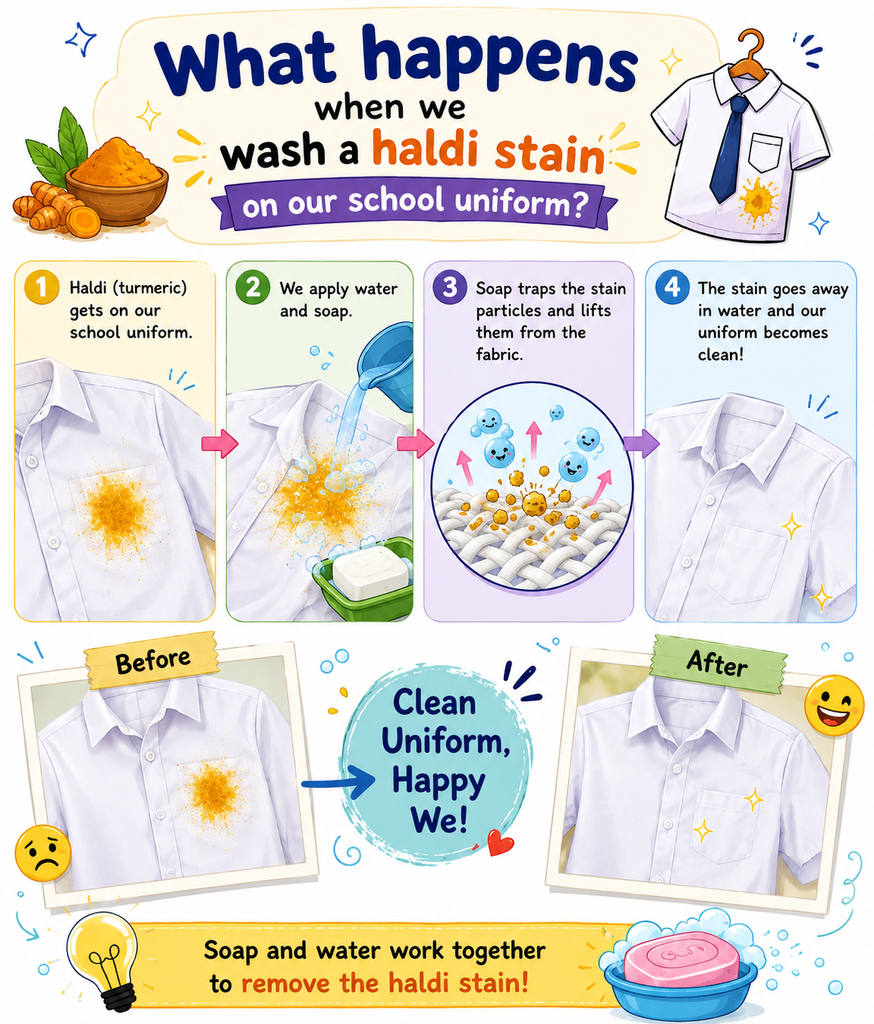
Soap solutions are generally alkaline. Therefore, when soap comes in contact with a turmeric stain, the stain may become reddish-brown.
After rinsing thoroughly, the effect may disappear as the alkaline material is removed.
This simple kitchen observation shows how science can be seen even while washing clothes.
💡 Extra Information
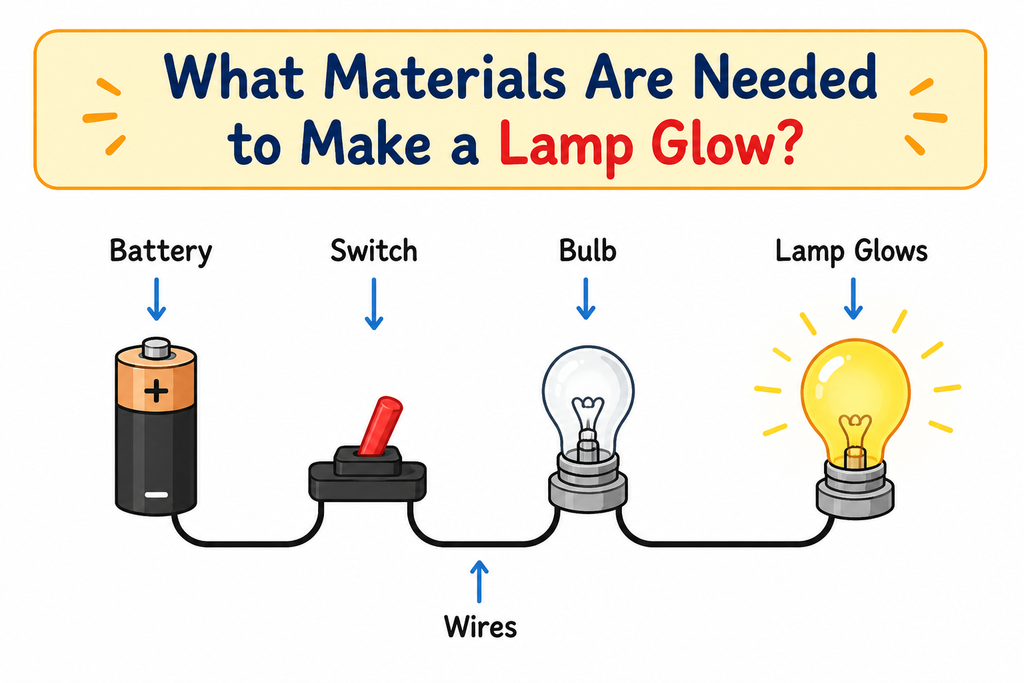
What Materials Are Needed to Make a Lamp Glow?
To make a lamp glow, we need a few basic components:
- Cell – provides electrical energy.
- Lamp (bulb) – glows when electric current passes through it.
- Connecting wires – connect the components and allow current to flow.
- Switch – opens or closes the circuit.
When all these components are connected properly to form a complete path, electric current flows through the circuit and the lamp glows.
Changes Around Us
The world around us is always changing. Ice melts, plants grow, food cooks, and iron objects may slowly rust.
Some changes can be reversed, while others cannot.
Some happen very quickly, while others may take days, months, or even years.
By observing these changes, we can learn how and why things around us change over time.
Flow of Heat and The Water Cycle
Have you ever wondered how water from rivers, lakes and oceans reaches the sky and later comes back as rain? Heat from the Sun plays an important role in this continuous movement of water.
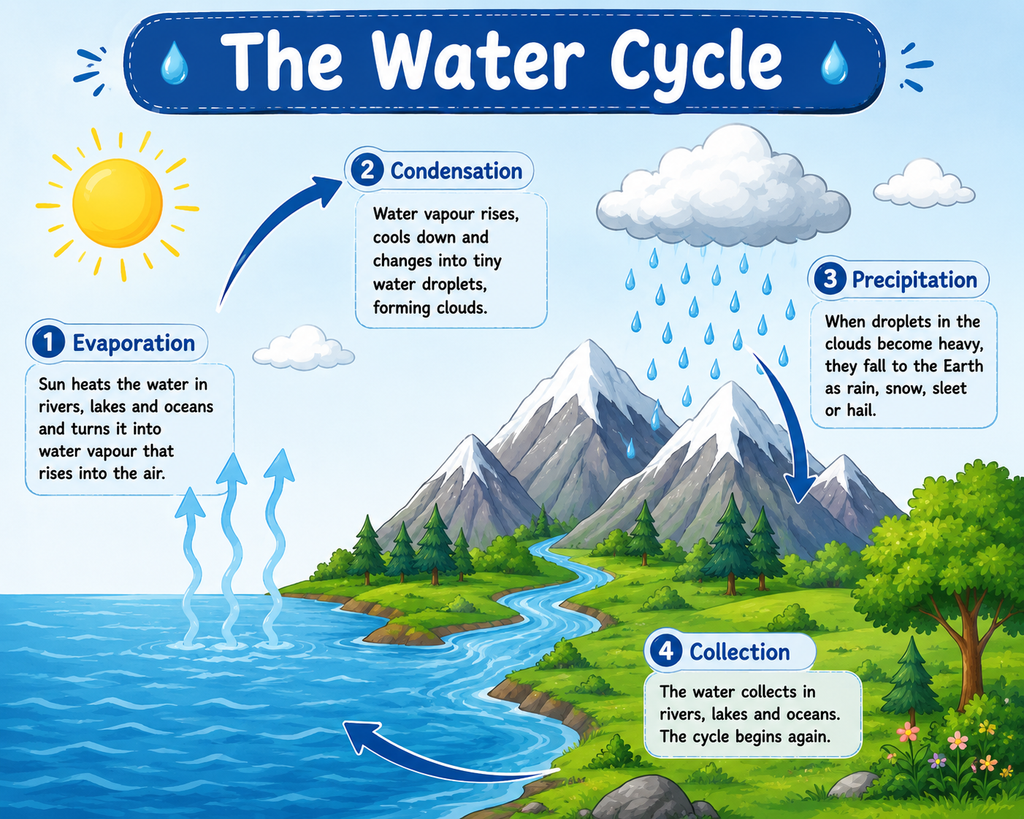
When the Sun heats water in oceans, rivers and lakes, some of it changes into water vapour and rises into the air. This process is called evaporation. Plants also release water vapour from their leaves through transpiration.
As the water vapour rises higher, it reaches cooler air and changes into tiny water droplets. This process is called condensation, and these tiny droplets gather together to form clouds.
When the water droplets in clouds become large and heavy, they fall to the Earth as rain, snow or hail. This is called precipitation.
The water then collects in rivers, lakes and oceans, while some of it seeps into the ground as groundwater. The Sun heats this water again, and the whole process continues. This continuous movement of water between the Earth and the atmosphere is called the water cycle.
Life Processes Essential for Survival
Have you ever wondered what keeps humans and other animals alive?
Our bodies are constantly carrying out important activities, even when we are sleeping.
Animals need food, breathe, grow, remove wastes, respond to their surroundings, and carry out other essential activities. These activities are known as life processes.
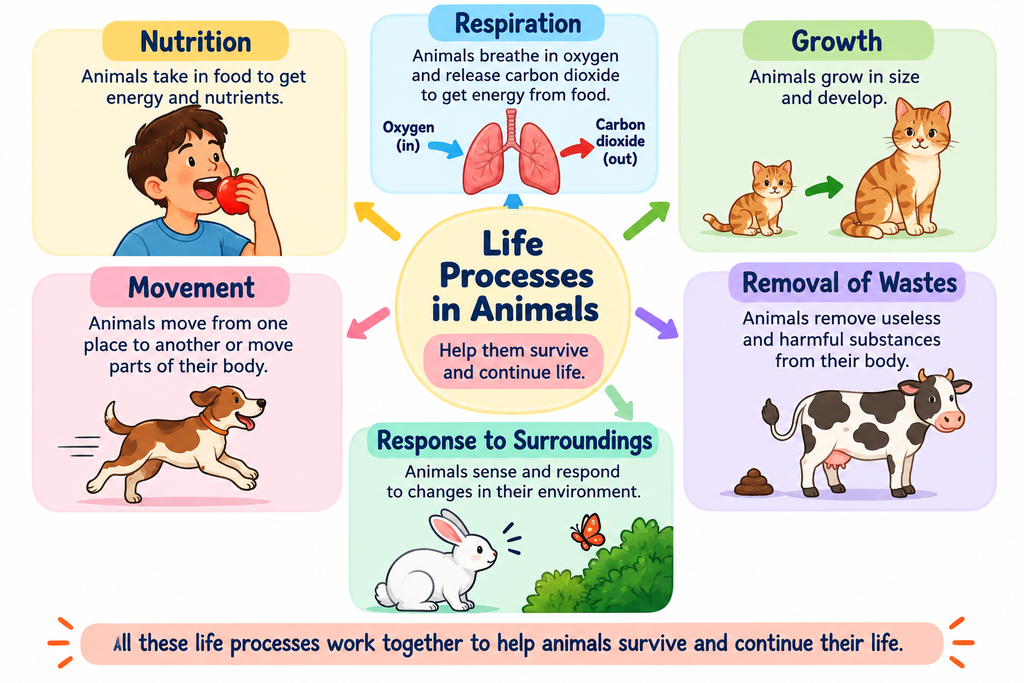
As we study living organisms, we discover how these processes work together to help them survive and continue life.
Do Plants Need Food to Grow? How Do They Get It? Do They Breathe?
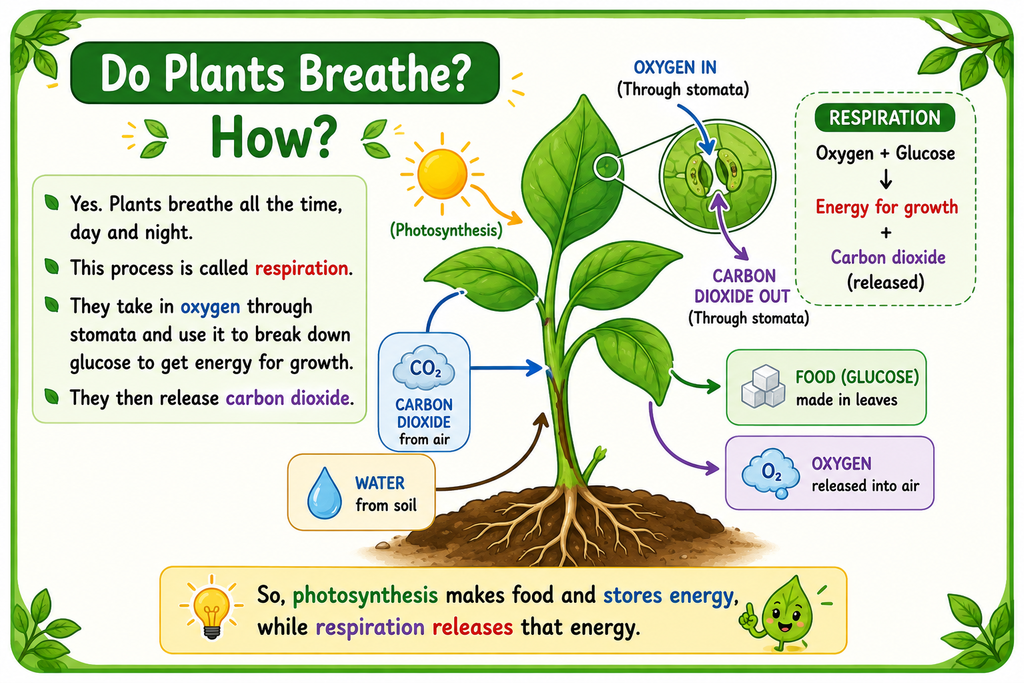
Yes, plants need food just like us, but they are amazing because they make their own food!
1.How do plants make food?
Plants make food by photosynthesis. This happens mainly in leaves. Leaves contain a green pigment called chlorophyll.
For photosynthesis, plants mainly need carbon dioxide, water and sunlight. Chlorophyll present in the leaves helps in this process.
• Carbon dioxide from air (enters through tiny pores called stomata)
• Water from soil (absorbed by roots)
• Sunlight
In the presence of sunlight and chlorophyll, they combine carbon dioxide and water to make glucose (food) and oxygen. This oxygen is released into the air, which we breathe.
Word Equation:
Carbon dioxide + Water –(Sunlight + Chlorophyll)–> Glucose (Food) + Oxygen
2.Do plants breathe? How?
Yes. Plants breathe all the time, day and night. This process is called respiration. They take in oxygen through stomata and use it to break down glucose to get energy for growth. They then release carbon dioxide. So, photosynthesis makes food and stores energy, while respiration releases that energy.
Light, Shadows and Eclipse.
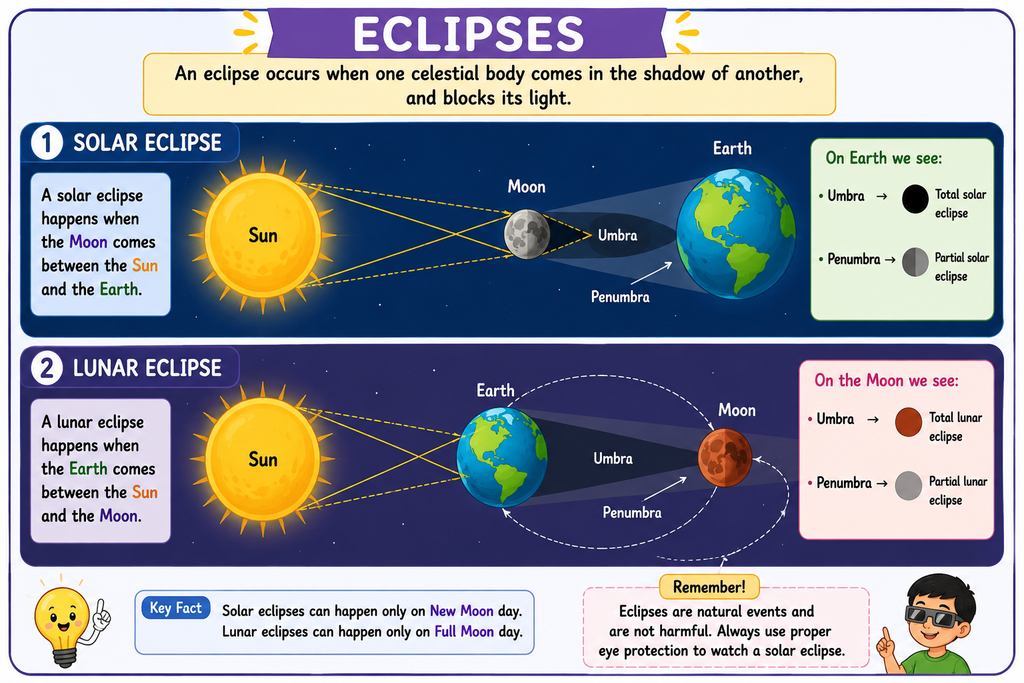
Have you ever noticed your shadow changing its size during the day? Or wondered why the Sun or Moon sometimes appears to become dark during an eclipse?
Light helps us see the world around us. When its path is blocked by an object, a shadow may form. On a much larger scale, the movement and positions of the Sun, Earth and Moon can produce fascinating events called eclipse.
Studying light and shadows helps us understand many interesting phenomena that we observe both on Earth and in the sky.
Movement of Earth and Its Effects.
Have you ever wondered why we have day and night, or why the seasons change during the year?
Earth is always moving. It rotates on its axis and also revolves around the Sun. These movements are connected with important changes that we experience, including day and night and seasonal changes.
By studying Earth’s movements, we can understand how events happening on an enormous scale in space affect our everyday lives here on Earth.
💡 KEY NOTE — THINK & Discuss curious, Creative & Fun Questions.
Think about these questions and discuss your ideas with your friends.
1. If the Moon is opaque, why does it shine at night? Where does its light actually come from?
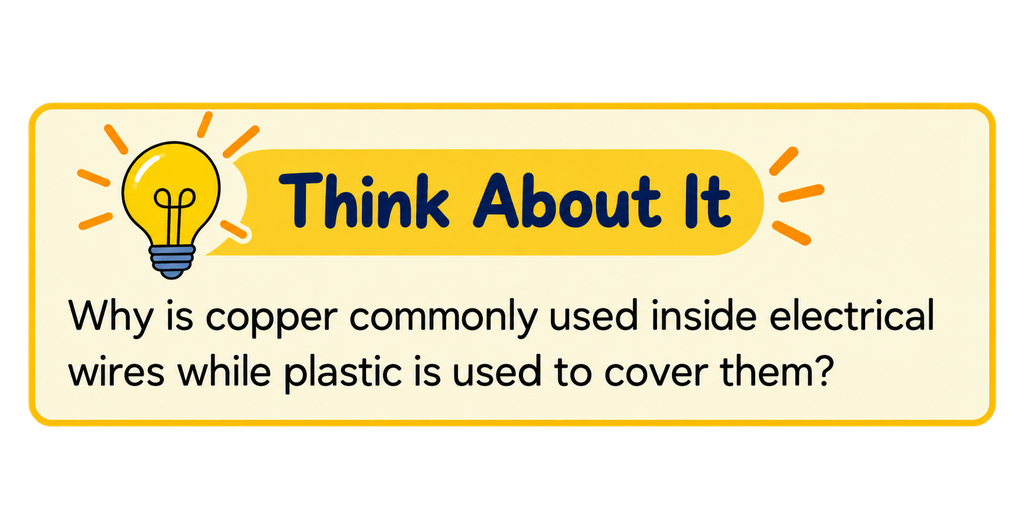
2. Why are cooking utensils usually made of metal, while their handles are often made of plastic or wood?
🤔 LET’S THINK!
Question 1. Your family wants to reduce electricity bills and also help the environment. Which two scientific ideas from this chapter would you suggest at home? (Hint: Think about sustainable energy and heat flow)
Question 2. One morning you notice a thick layer of fog and your uniform feels damp, but by afternoon it is dry and sunny. Which process of the water cycle explains this? Why should we not waste water even though the water cycle never stops?
Conclusion
The world of science is ever-evolving because our questions never stop. From why haldi changes colour to why we have seasons, every answer leads to a new question and a better way of living.
As a Class 7 student, you are not just learning facts for an exam. You are learning to observe carefully, ask why things happen, test your ideas, and use your knowledge to make our society healthier and our planet more sustainable. Keep your curiosity alive – that is the real spirit of a scientist.
Frequently Asked Questions (FAQs)
1. Why is science called an ever-evolving subject?
Science keeps developing as scientists make new observations, discoveries and inventions. New evidence can improve our understanding of the world.
2. How is science connected to our everyday life?
Science is present in almost everything we do—from cooking food and using electricity to travelling, communicating and understanding our bodies and surroundings.
3. How can science help protect the environment?
Science helps us develop cleaner energy, save water, manage waste, reduce pollution and use natural resources more responsibly.
4. Why do different materials have different uses?
Different materials have different properties. We choose a material according to the purpose for which it is needed.
5. Why is the Sun important for the water cycle?
Heat from the Sun causes evaporation, which helps water move from the Earth’s surface into the atmosphere and keeps the water cycle going.
6. Why should students learn science through everyday examples?
Everyday examples help students connect scientific ideas with things they actually observe, making science easier to understand and remember.