Introduction: A World Full of Wonders
Have you ever wondered why the stars appear to shine at night? Why do flowers bloom in different seasons? How does a tiny seed grow into a large plant? Why does a wet road dry after some time? Or how does sunlight help us get energy?
The answers to these questions take us into the wonderful world of science.
Science is not something we encounter only in a classroom or laboratory. It is all around us. We see it when sunlight warms our face, when a plant grows in the garden, when rain falls from clouds, when a rainbow appears in the sky, and even when we use a mobile phone or switch on a light.
Every single day, your mind asks dozens of questions like these. That natural urge to ask “How?” and “Why?” is where our journey into science begins.
Table of Contents
What is Science, Really?
Many people imagine science as a thick textbook packed with tricky formulas, or a quiet laboratory full of glass beakers and bubbling liquid. But science is far more exciting than that.
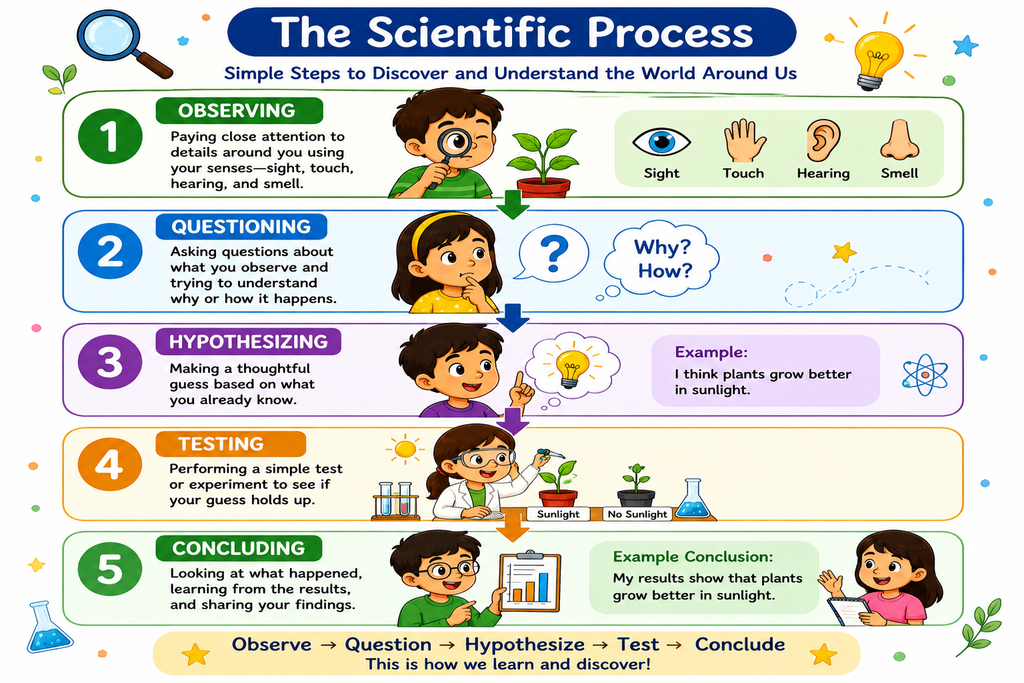
Science is a systematic way of understanding the natural world through observation, questioning, investigation, and evidence.
In simple words, science helps us understand how and why things happen around us.
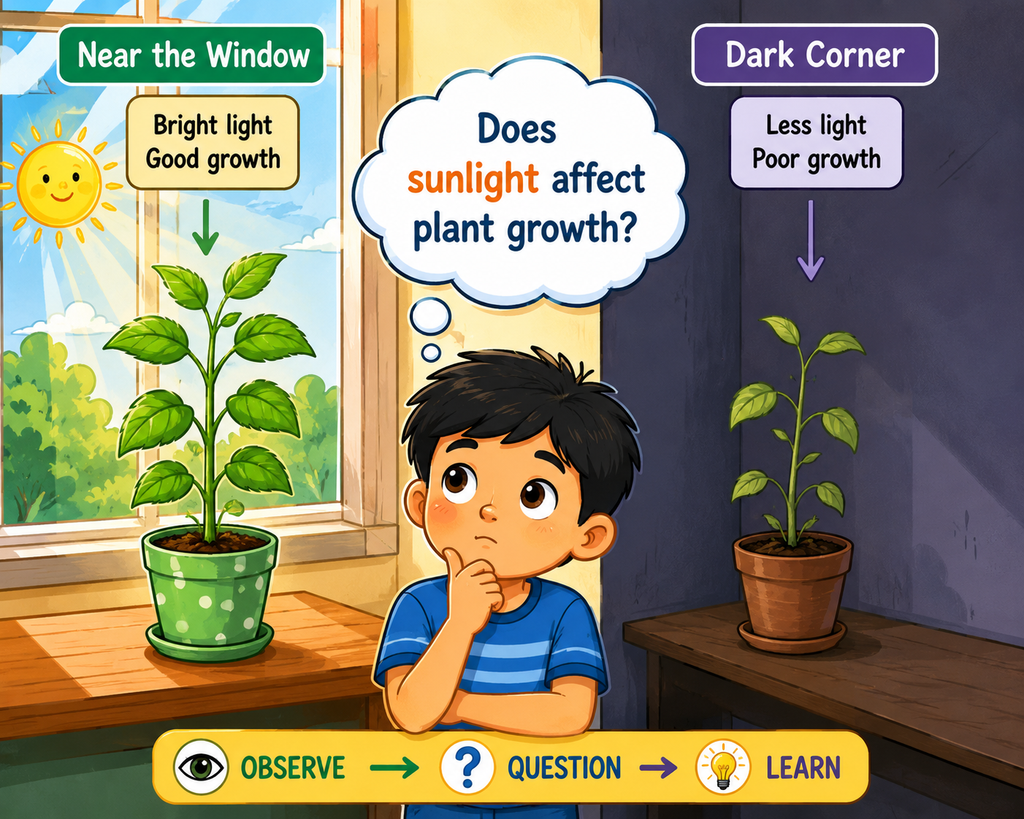
You can then observe the plants, compare them, and investigate what happens. This habit of asking questions and looking for evidence is an important part of scientific thinking.
Science does not mean memorising hundreds of facts. It is about:
- observing carefully
- thinking logically
- asking questions
- testing ideas
- learning from evidence
Science Begins With Curiosity
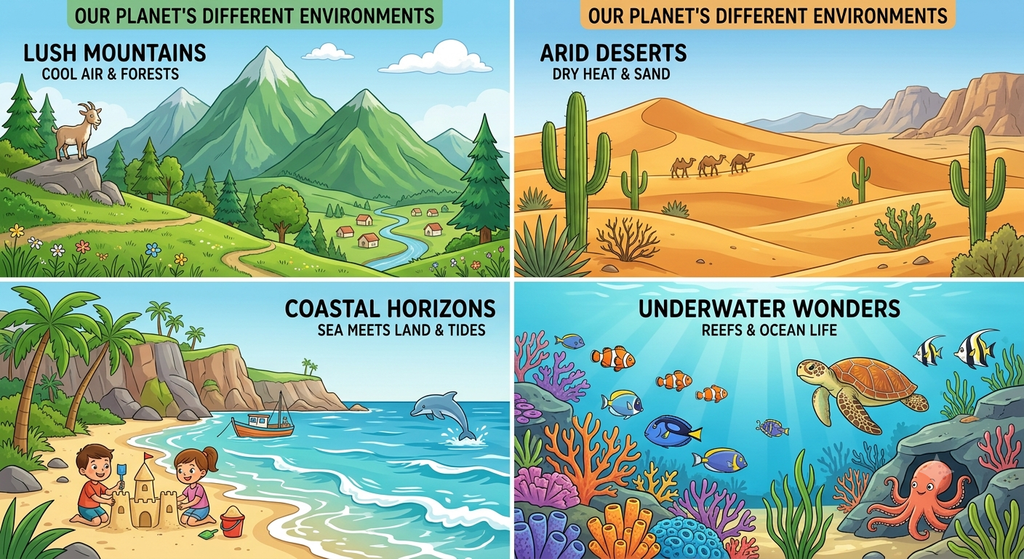
Science is not limited to laboratories. The whole Earth can be thought of as a giant science lab. Look outside your classroom for a moment. You may see trees, clouds, birds, roads, buildings, soil and sunlight. Every one of these can be connected with science. The natural world is full of different environments.
A green mountain region, for example, may have cool air, forests, streams, and many kinds of plants and animals.
A desert looks very different. It receives much less rainfall than many other regions, so plants and animals living there have special ways of surviving with limited water.
At the coast, land meets the sea. Waves, tides, wind, and weather continually affect the coastline.
Under the surface of the ocean is another amazing world. Ocean water provides a home for fish, corals, sea plants, and many other organisms.
And beyond Earth lies an enormous universe containing stars, planets, galaxies, and much more.
Science in Every Moment of Daily Life
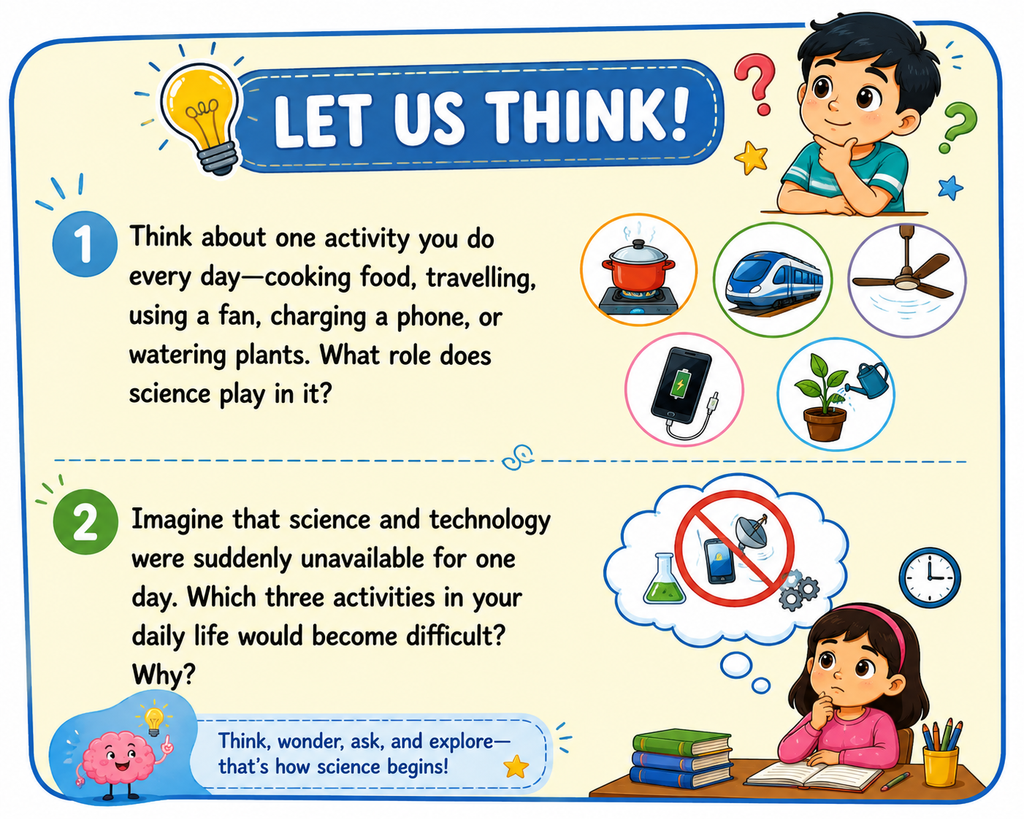
You do not need to visit a mountain top or launch a rocket into space to experience science. It is happening all around you right now, in your home, classroom, and kitchen. We often think of science as something complicated, but many scientific ideas can be seen in ordinary activities.
- Solar Energy
The Sun is the main natural source of energy for life on Earth. Plants use sunlight to make their food, and solar panels can convert sunlight into electrical energy. Solar energy is useful because sunlight is naturally available in many places and does not produce smoke while a solar panel is generating electricity.
Sunlight → Solar panel → Electrical energy
- Reflection of Light
Have you ever looked into a mirror and seen your face? This happens because light from your face falls on the mirror and is reflected towards your eyes. This property of light is called reflection. Mirrors are useful in homes, vehicles, and many scientific instruments because they can reflect light.
- Photosynthesis
Plants may appear to simply stand in one place, but they are constantly carrying out important processes. Green plants use sunlight, water and carbon dioxide to prepare their food. This process is called photosynthesis.
“We can understand the process simply as:”
Sunlight + Water + Carbon dioxide → Food + Oxygen
The food made by plants provides energy for their growth. Plants also release oxygen during photosynthesis, which is important for many living organisms.
- Changes in the Earth
The Earth is not completely unchanging. Wind, flowing water, temperature changes and other natural forces can slowly change rocks and landforms.
For example, flowing water can wear away soil and rock and carry the particles to another place. Over a long period, such processes can change the shape of the land. These changes may happen so slowly that we do not notice them from one day to the next.
- Ecosystems
A pond, forest or garden is more than just a collection of plants and animals. Living organisms interact with one another and with non-living things such as water, air, soil and sunlight. Such a system is called an ecosystem.
For example, in a garden, plants depend on sunlight, water and soil. Insects may feed on plants, birds may feed on insects, and decomposers help return nutrients to the soil. All these living and non-living parts are connected to one another.
The Science Behind ‘Why’?
One of the most exciting parts of science is discovering the reason behind things we see every day.
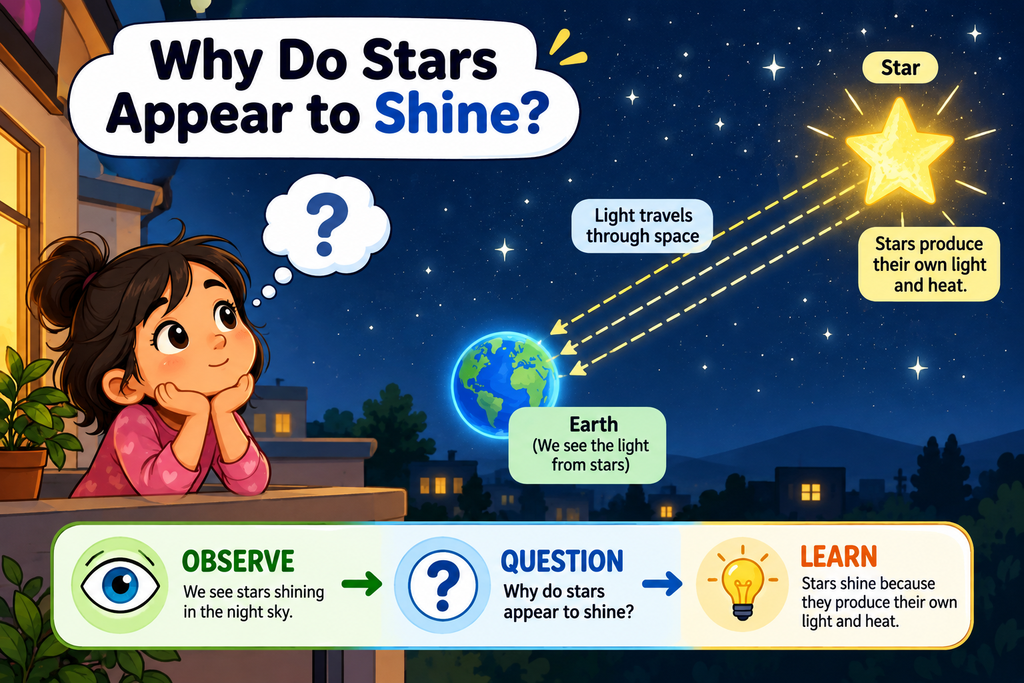
Why Do Stars Appear to Shine?
On a clear night, the sky seems to be filled with tiny shining points. These are mostly stars, and stars produce their own light.
Our Sun is also a star. It appears much larger and brighter than the other stars because it is much closer to Earth.
Why Do Flowers Bloom?
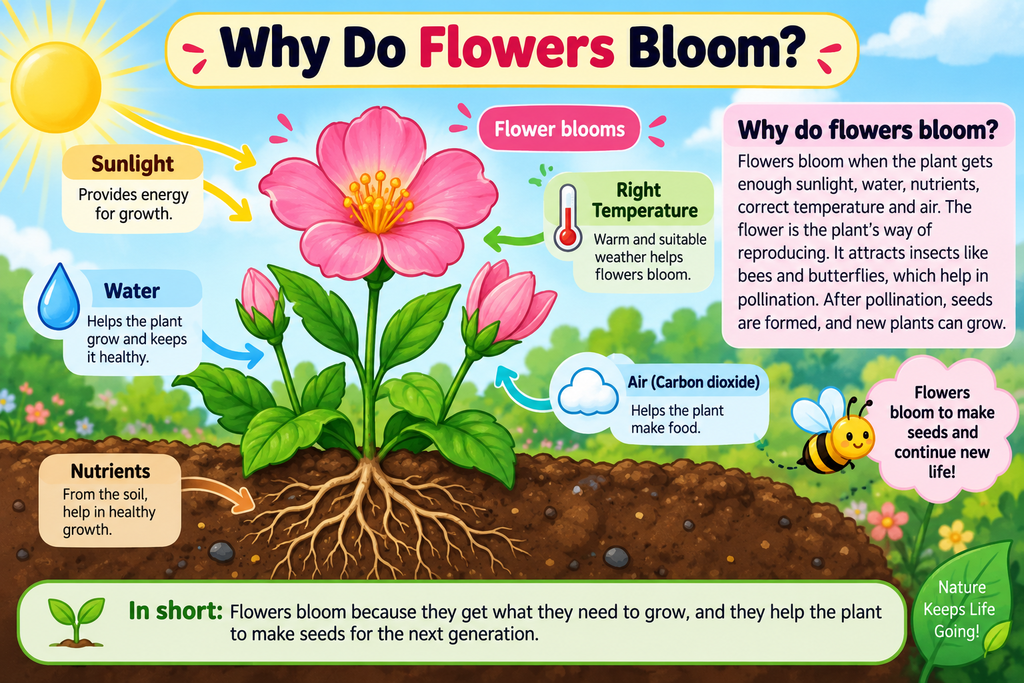
Plants produce flowers as a natural part of their life cycle. Flowering is a natural part of the life of many plants and is influenced by factors such as the type of plant, its stage of growth, temperature and the amount of light it receives.
Flowers are important in the reproduction of many flowering plants because they contain structures involved in forming seeds.
How Does a Seed Germinate?
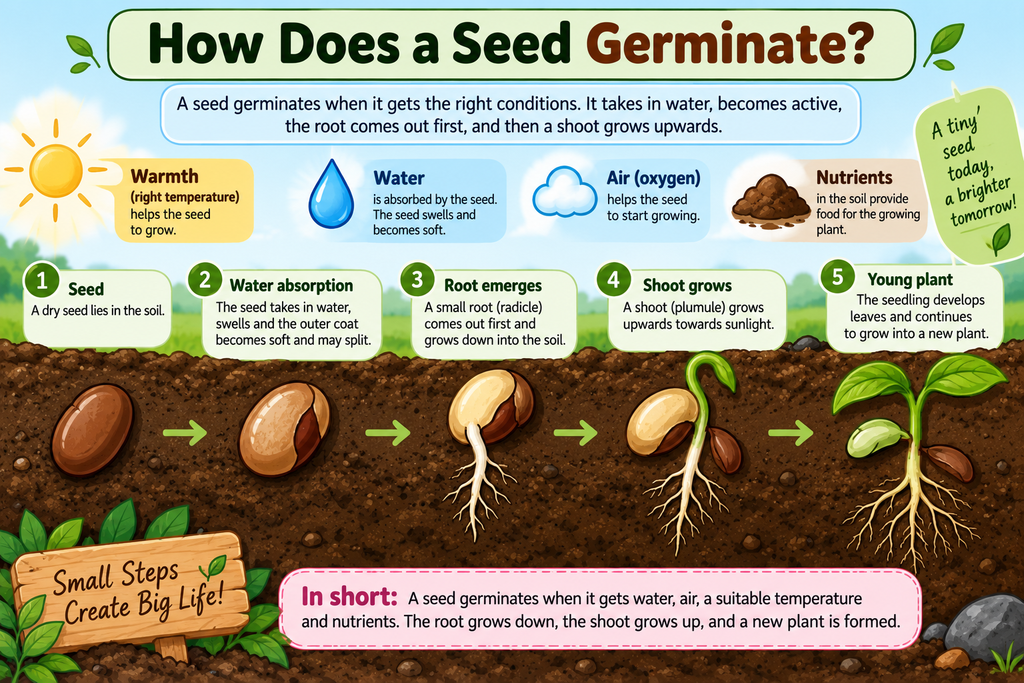
A seed germinates when it gets water, air, and a suitable temperature. It absorbs water and swells, causing the seed coat to soften and break. First, a small root grows downward into the soil. Then, a shoot grows upward towards the light. Gradually, leaves develop and the seedling grows into a young plant.
In short:
Seed → Root → Shoot → Seedling → Young Plant
Important Life Cycles In Nature
A life cycle shows the different stages a living organism passes through during its life, from its beginning through growth, reproduction, and the start of a new generation.
(1) Plant Life Cycle-: A plant’s life cycle begins with a tiny seed and eventually leads to the formation of new seeds.
When a seed gets suitable conditions, it germinates and develops into a young plant. The young plant grows leaves and gradually becomes a mature plant. When mature, it may produce flowers. After pollination and other processes involved in reproduction, new seeds develop. These seeds can then grow into new plants, and the life cycle begins again.
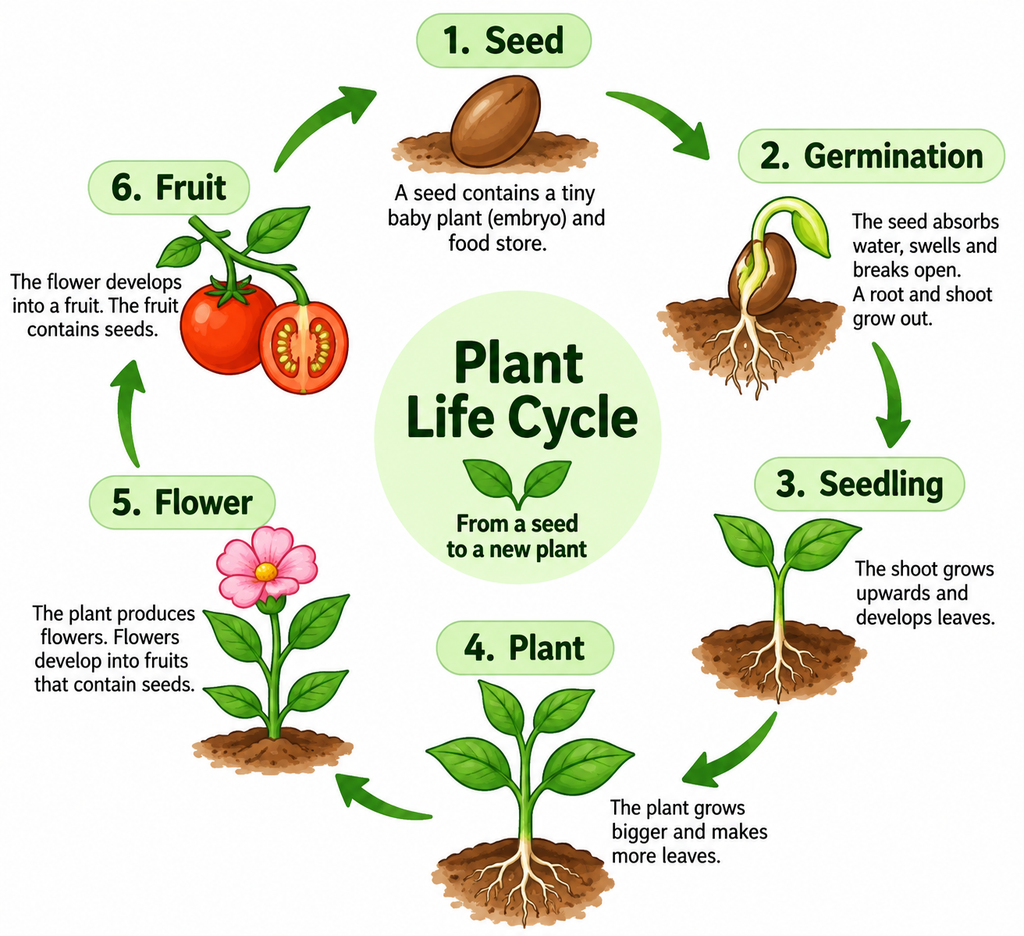
Labelled Diagram of Plant Life Cycle – Seed to Seed
(2) Life Cycle of Silkworm (Metamorphosis)
The silkworm has a particularly interesting life cycle. It goes through several distinct stages, and its body changes greatly as it develops. This type of major change in body form is called metamorphosis.
The cycle begins with an egg. A small larva, commonly called a silkworm, hatches from the egg. The larva feeds mainly on mulberry leaves and grows larger.
When it is fully grown, the silkworm spins a silk thread around itself to form a protective covering called a cocoon. Inside the cocoon, it changes into the next stage, called a pupa.
Later, an adult moth emerges. The adult moth lays eggs, beginning the cycle again.
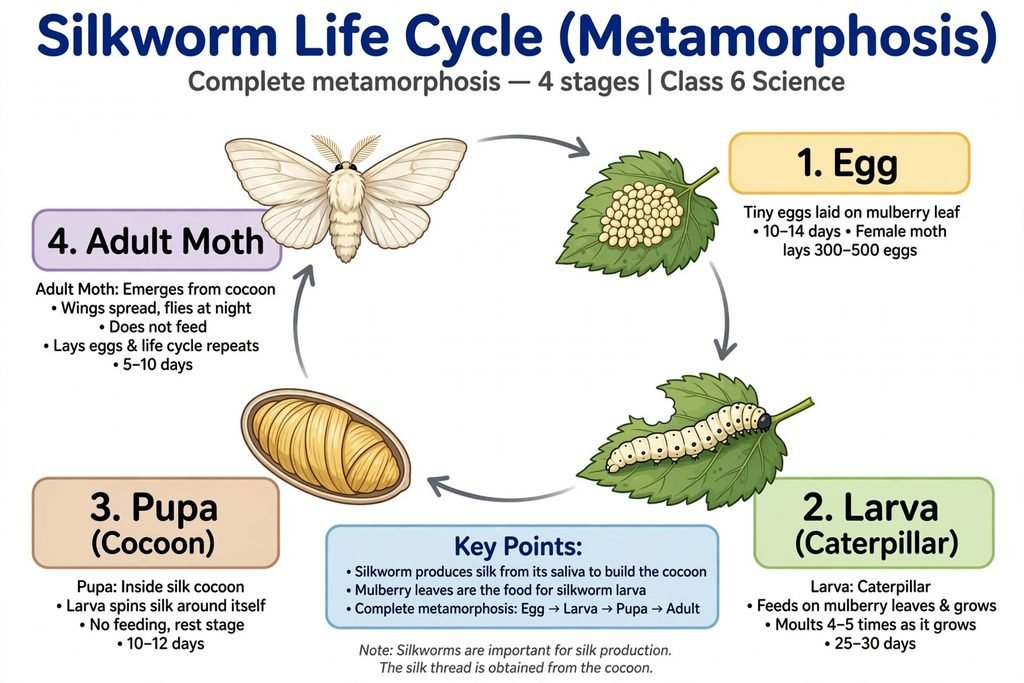
Labelled Diagram of Life Cycle of Silkworm – Egg -> Larva -> Pupa -> Adult
Conclusion: Keep Your Curiosity Alive!
The wonderful world of science is not far away—it is in your kitchen when water boils, in your garden when bees visit flowers, in your mobile phone, and even inside your own body when you breathe.
Science teaches us three important habits: to observe carefully, to ask questions, and to look for answers using evidence. It is not about memorising big definitions, but about understanding how and why things happen in nature.
You are starting this beautiful journey. Keep your curiosity alive. Ask why the moon changes shape, how a pressure cooker works, or why your shadow is long in the evening. Every great scientist was once a curious learner like you.
So go out, look around, experiment safely, and enjoy—because the whole world is waiting to be discovered!
Frequently Asked Questions (FAQs)
1. What is science in simple words?
Science is a way of understanding the natural world by observing, asking questions, investigating and using evidence.
2. Is science present in our everyday life?
Yes. Science is involved in activities such as cooking, travelling, using electricity, growing plants, communicating and using technology.
3. Why is science important?
Science helps us understand nature, solve problems, develop useful technologies and make informed decisions about the world around us.
4. What is photosynthesis?
Photosynthesis is the process by which green plants use sunlight, water and carbon dioxide to make food.
5. What is a life cycle?
A life cycle shows the different stages through which a living organism passes during its life.
6. What is metamorphosis?
Metamorphosis is a major change in body form during the development of certain animals. The silkworm is an example because it passes through egg, larva, pupa and adult stages.
7. Why do plant leaves look green?
Plant leaves look green because they contain a natural green pigment called chlorophyll. Chlorophyll captures energy from sunlight, which plants use to make food during photosynthesis.