Preparing for your Class 10 Science Board Exam? You’ve got this! 🌟Chemical Reactions and Equations is an important chapter, and a little focused practice can make a big difference. Don’t worry if some questions seem difficult at first. Read each question carefully, understand the concept behind it, and try to answer in your own words.This collection of important board-exam questions is designed to help you revise the chapter, practise different types of questions, and build confidence before your exam. Keep practising, stay consistent, and believe in your preparation—you are more ready than you think! 💪📖
📚 Table of Contents
- Chapter in a Nutshell: Chemical Reactions and Equations
- Important 1-Mark MCQs – Chemical Reactions and Equations
- Important 2-Mark Questions – Chemical Reactions and Equations
- Important 3-Mark Questions – Chemical Reactions and Equations
- Important 5-Mark Questions – Chemical Reactions and Equations
- Competency-Based Questions (CBSE Board Pattern)
- Assertion–Reasoning Type Questions
- Practice Worksheet (Self-Assessment)
🧪 Chapter in a Nutshell: Chemical Reactions and Equations
Think of chemistry as a story of change.
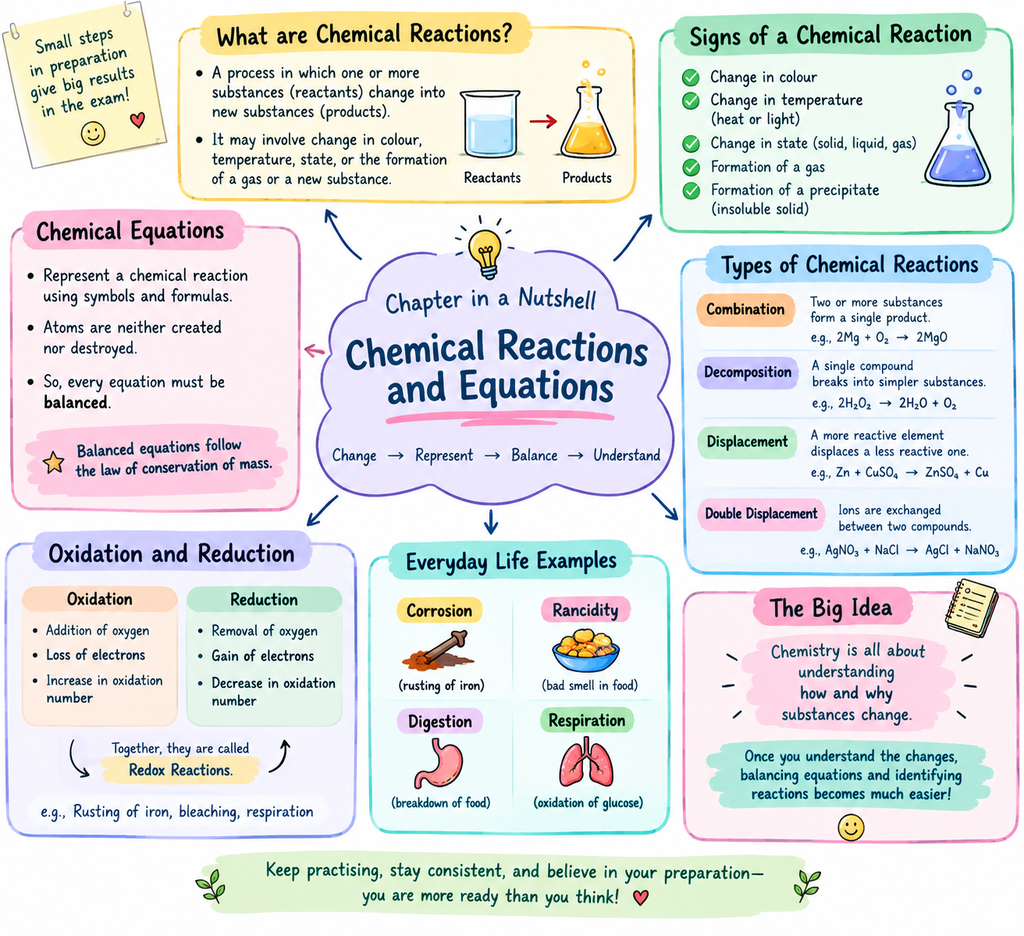
Need a quick revision before attempting these questions?
Read our detailed Class 10 Science Chapter 1 – Chemical Reactions and Equations notes first. They cover the key concepts, types of chemical reactions, oxidation and reduction, corrosion, rancidity, and important chemical equations in a simple, exam-friendly way.
👉 Read the complete chapter notes here: Chemical Reactions and Equations – Class 10 Science Chapter 1
Important 1-Mark MCQs – Chemical Reactions and Equations
These 1-mark questions are useful for quick revision and cover important concepts, definitions, chemical equations, and everyday examples from the chapter.
1. Which of the following observations indicates that a chemical reaction has taken place?
A. Change in the shape of a substance
B. Formation of a new substance
C. Melting of ice
D. Dissolving sugar in water
Answer: B. Formation of a new substance
2. Which of the following is a combination reaction?
A. CaCO₃ → CaO + CO₂
B. Zn + CuSO₄ → ZnSO₄ + Cu
C. CaO + H₂O → Ca(OH)₂
D. AgNO₃ + NaCl → AgCl + NaNO₃
Answer: C. CaO + H₂O → Ca(OH)₂
3. Which type of reaction is represented by the equation below?
2AgBr → 2Ag + Br₂
A. Combination reaction
B. Decomposition reaction
C. Displacement reaction
D. Double displacement reaction
Answer: B. Decomposition reaction
4. In the reaction
Zn + CuSO₄ → ZnSO₄ + Cu
which substance is displaced?
A. Zinc
B. Copper
C. Sulphate
D. Zinc sulphate
Answer: B. Copper
5. Which of the following reactions is a double displacement reaction?
A. 2Mg + O₂ → 2MgO
B. CaCO₃ → CaO + CO₂
C. Fe + CuSO₄ → FeSO₄ + Cu
D. Na₂SO₄ + BaCl₂ → BaSO₄ + 2NaCl
Answer: D. Na₂SO₄ + BaCl₂ → BaSO₄ + 2NaCl
6. Which gas is evolved when zinc reacts with dilute hydrochloric acid?
A. Oxygen
B. Nitrogen
C. Hydrogen
D. Carbon dioxide
Answer: C. Hydrogen
7. Which of the following is an example of an exothermic reaction?
A. Photosynthesis
B. Thermal decomposition of calcium carbonate
C. Respiration
D. Electrolysis of water
Answer: C. Respiration
8. Which process is responsible for the reddish-brown coating formed on iron?
A. Rancidity
B. Corrosion
C. Neutralisation
D. Sublimation
Answer: B. Corrosion
9. Rancidity can be prevented by:
A. Increasing exposure to oxygen
B. Keeping food exposed to sunlight
C. Storing food in airtight containers
D. Increasing the temperature of food
Answer: C. Storing food in airtight containers
10. In a redox reaction, oxidation and reduction:
A. Always occur separately
B. Occur simultaneously
C. Occur only in decomposition reactions
D. Occur only in combination reactions
Answer: B. Occur simultaneously
Important 2-Mark Questions – Chemical Reactions and Equations
2-mark questions are designed to test your understanding of important concepts and your ability to explain them briefly. Practise answering these questions in clear, precise language and include chemical equations or examples wherever required.
1. What is a chemical reaction? Mention any two observations that indicate that a chemical reaction has taken place.
Answer: A chemical reaction is a process in which one or more substances change to form new substances with different properties.
Two observations are:
- Change in colour
- Evolution of a gas
2. Why should a magnesium ribbon be cleaned before burning in air?
Answer: A magnesium ribbon is cleaned before burning to remove the thin layer of magnesium oxide formed on its surface. This allows magnesium to react properly with oxygen in the air.
3. What is a balanced chemical equation? Why is it necessary to balance a chemical equation?
Answer: A balanced chemical equation has an equal number of atoms of each element on both sides of the equation.
It is necessary to balance an equation to obey the law of conservation of mass.
4. Differentiate between oxidation and reduction.
Answer:
| Oxidation | Reduction |
|---|---|
| Addition of oxygen or removal of hydrogen. | Removal of oxygen or addition of hydrogen. |
| It can also involve loss of electrons. | It can also involve gain of electrons |
5. What is a displacement reaction? Give one example.
Answer: A displacement reaction is a reaction in which a more reactive element displaces a less reactive element from its compound.
Example:
Zn + CuSO₄ → ZnSO₄ + Cu
Important 3-Mark Questions – Chemical Reactions and Equations
3-mark questions require a clear understanding of the concept along with a well-organised answer. Write each point carefully, use suitable chemical equations or examples where required, and make sure your answer addresses every part of the question.
1. Balance the following chemical equation and identify the type of reaction:
Fe + H₂O → Fe₃O₄ + H₂
Answer:
The balanced equation is:
3Fe + 4H₂O → Fe₃O₄ + 4H₂
This is a redox reaction because oxidation and reduction occur simultaneously.
2. What happens when an iron nail is placed in copper sulphate solution? Write the chemical equation and mention the colour change observed.
Answer:
When an iron nail is placed in copper sulphate solution, iron displaces copper from copper sulphate because iron is more reactive than copper.
Fe + CuSO₄ → FeSO₄ + Cu
The blue colour of the copper sulphate solution gradually changes to green due to the formation of ferrous sulphate, and a reddish-brown deposit of copper forms on the iron nail.
3. Explain the difference between combination and decomposition reactions with one example of each.
Answer:
A combination reaction is a reaction in which two or more substances combine to form a single product.
CaO + H₂O → Ca(OH)₂
A decomposition reaction is a reaction in which a single compound breaks down into two or more simpler substances.
CaCO₃ → CaO + CO₂
4. Explain oxidation and reduction in terms of oxygen and hydrogen. Give one example.
Answer:
Oxidation involves the addition of oxygen or removal of hydrogen from a substance.
Reduction involves the removal of oxygen or addition of hydrogen to a substance.
For example:
CuO + H₂ → Cu + H₂O
Here, CuO loses oxygen and is reduced, while H₂ gains oxygen and is oxidised.
5. What is corrosion? Explain any two methods of preventing corrosion.
Answer:
Corrosion is the gradual destruction of a metal due to its reaction with substances present in the environment, such as oxygen and moisture.
Two methods of preventing corrosion are:
- Painting or oiling: It prevents the metal surface from coming into contact with air and moisture.
- Galvanisation: Iron is coated with a layer of zinc to protect it from corrosion.
Important 5-Mark Questions – Chemical Reactions and Equations
5-mark questions require detailed and well-structured answers. Read each question carefully, cover all the required points, and support your explanation with balanced chemical equations and suitable examples wherever needed.
1. Explain the different types of chemical reactions with one balanced chemical equation for each type.
Answer:
Chemical reactions can be classified into different types based on how reactants change into products:
(a). Combination reaction:
Two or more substances combine to form a single product.
CaO + H₂O → Ca(OH)₂
(b). Decomposition reaction:A single compound breaks down into two or more simpler substances.
CaCO₃ → CaO + CO₂
(c). Displacement reaction:
A more reactive element displaces a less reactive element from its compound.
Zn + CuSO₄ → ZnSO₄ + Cu
(d). Double displacement reaction:
Two compounds exchange their ions to form two new compounds.
Na₂SO₄ + BaCl₂ → BaSO₄ + 2NaCl
2. Explain oxidation and reduction with the help of a suitable chemical equation. Also mention two effects of oxidation in everyday life.
Answer:
Oxidation and reduction are chemical processes that occur together in a redox reaction.
Consider:
CuO + H₂ → Cu + H₂O
- CuO loses oxygen and is therefore reduced to copper.
- H₂ gains oxygen and is therefore oxidised to water.
Thus, oxidation and reduction occur simultaneously, making the reaction a redox reaction.
Two effects of oxidation in everyday life are:
- Corrosion: Metals such as iron undergo oxidation in the presence of air and moisture, resulting in rust formation.
- Rancidity: Oxidation of fats and oils in food causes an unpleasant smell and taste.
3. What is corrosion? Explain the conditions necessary for rusting of iron and describe any three methods of preventing corrosion.
Answer:
Corrosion is the gradual deterioration of a metal due to chemical reactions with substances present in the environment.
For iron to rust, both oxygen and water (moisture) are necessary.
The following methods can be used to prevent corrosion:
- Painting: A layer of paint prevents iron from coming into contact with air and moisture.
- Oiling or greasing: It forms a protective layer on the metal surface.
- Galvanisation: Iron is coated with zinc, which protects it from corrosion.
Other methods include alloying and electroplating.
4. Explain the following reactions with balanced chemical equations:
(a) Reaction of zinc with dilute hydrochloric acid
(b) Reaction of iron with copper sulphate solution
(c) Reaction of silver chloride in sunlight
Answer:
(a) Zinc with dilute hydrochloric acid:
Zinc reacts with dilute hydrochloric acid to form zinc chloride and hydrogen gas.
Zn + 2HCl → ZnCl₂ + H₂
(b) Iron with copper sulphate solution:
Iron displaces copper from copper sulphate solution.
Fe + CuSO₄ → FeSO₄ + Cu
(c) Silver chloride in sunlight:
Silver chloride decomposes in the presence of sunlight to form silver and chlorine gas.
2AgCl → 2Ag + Cl₂
5. What is rancidity? Explain four methods by which rancidity can be prevented.
Answer:
Rancidity is the oxidation of fats and oils in food, which causes an unpleasant smell and taste.
Rancidity can be prevented by:
- Storing food in airtight containers to reduce contact with oxygen.
- Refrigerating food to slow down oxidation.
- Adding antioxidants to prevent oxidation of fats and oils.
- Packing food with nitrogen gas to reduce the amount of oxygen in the package.
6. What is a chemical equation? Explain the importance of balancing a chemical equation and balance the following equation:
Al + HCl → AlCl₃ + H₂
Answer:
A chemical equation is a symbolic representation of a chemical reaction using the chemical formulae of the reactants and products.
A chemical equation must be balanced because the law of conservation of mass states that atoms are neither created nor destroyed during a chemical reaction.
The balanced equation is:
2Al + 6HCl → 2AlCl₃ + 3H₂
6. A student performs the following reactions in the laboratory:
(a) Calcium oxide is mixed with water.
(b) Lead nitrate solution is mixed with potassium iodide solution.
(c) Silver chloride is exposed to sunlight.
Identify the type of reaction in each case and write the balanced chemical equation.
Answer:
(a) Calcium oxide with water — Combination reaction
CaO + H₂O → Ca(OH)₂
Two substances combine to form a single product.
(b) Lead nitrate with potassium iodide — Double displacement reaction
Pb(NO₃)₂ + 2KI → PbI₂ + 2KNO₃
A yellow precipitate of lead iodide (PbI₂) is formed.
(c) Silver chloride in sunlight — Decomposition reaction
2AgCl → 2Ag + Cl₂
Silver chloride decomposes into silver and chlorine in the presence of sunlight.
Need help with NCERT exercise questions? Check our NCERT Solutions for Class 10 Science Chapter 1 – Chemical Reactions and Equations for detailed, easy-to-understand answers and explanations.
Competency-Based Questions (CBSE Board Pattern)
Competency-based questions test your ability to apply concepts in real-life situations, not just remember definitions. Read each case carefully, identify the chemical reaction involved, and use your understanding of the chapter to answer the questions clearly and logically.
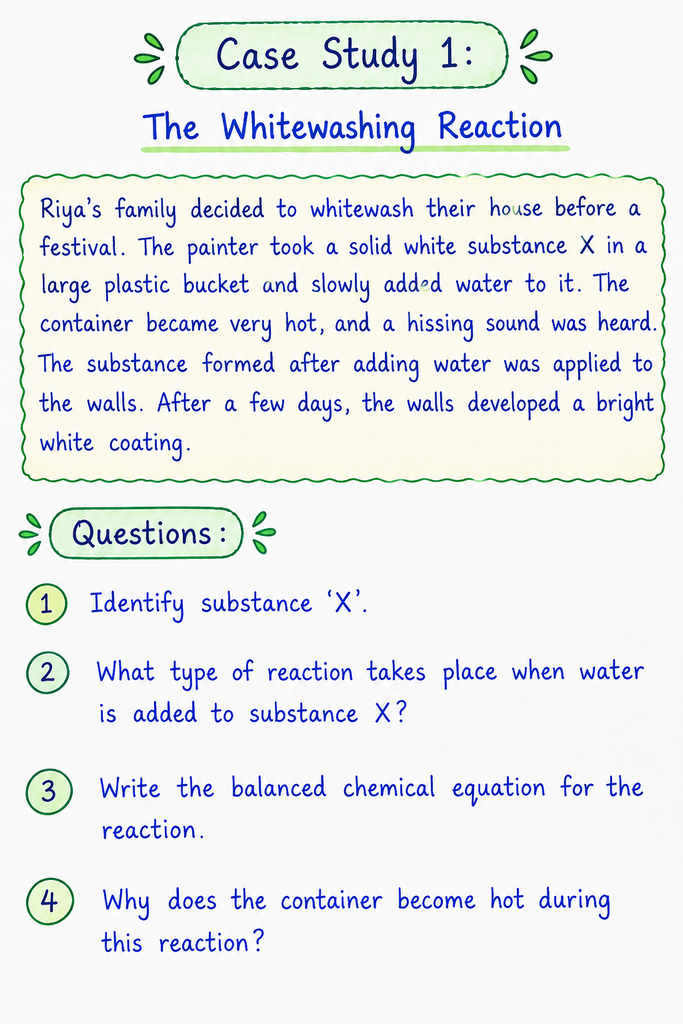
Answers:
(1) Substance X is calcium oxide (CaO), commonly known as quicklime.
(2) It is a combination reaction because calcium oxide combines with water to form a single product, calcium hydroxide.
(3) CaO + H₂O → Ca(OH)₂
(4) The reaction releases heat, so it is an exothermic reaction.
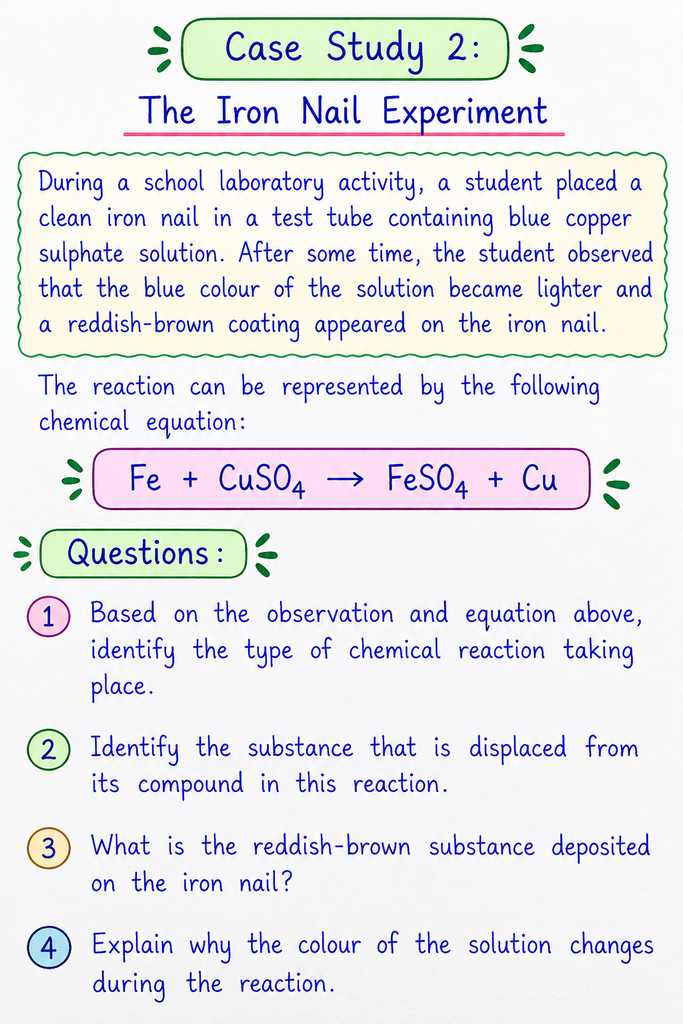
Answers:
(1) It is a displacement reaction because iron displaces copper from copper sulphate solution.
(2) Copper (Cu) is displaced from copper sulphate (CuSO₄) by iron.
(3) The reddish-brown substance is copper (Cu).
(4) Iron displaces copper from copper sulphate and forms iron sulphate (FeSO₄). Since copper sulphate solution is blue and iron sulphate solution is pale green, the colour of the solution changes from blue to pale green.
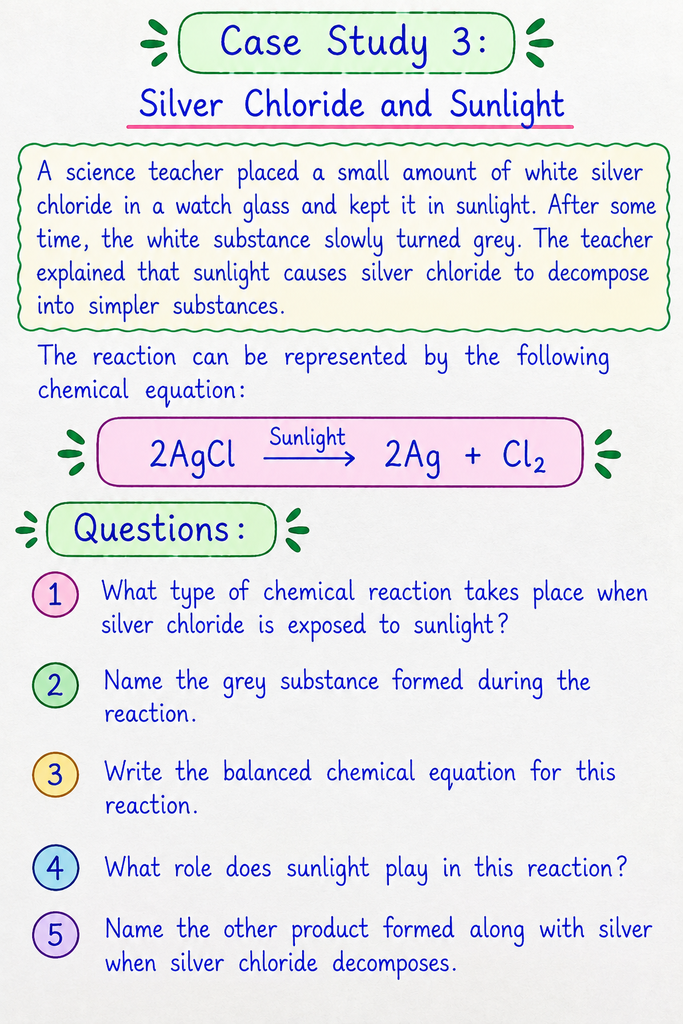
Answers:
(1) It is a decomposition reaction because silver chloride breaks down into simpler substances in the presence of sunlight.
(2) The grey substance formed is silver (Ag).
(3) 2AgCl → 2Ag + Cl₂
(in the presence of sunlight)
(4) Sunlight provides the energy required to decompose silver chloride into silver and chlorine.
(5) The other product formed is chlorine gas (Cl₂).
Assertion–Reasoning Type Questions
These questions test your understanding of concepts and your ability to connect a statement with the reason behind it. Read both the Assertion and Reason carefully before choosing the correct option.
Directions: In the following questions, a statement of Assertion (A) is followed by a statement of Reason (R). Choose the correct option:
a) Both (A) and (R) are true, and (R) is the correct explanation of (A).
(b) Both (A) and (R) are true, but (R) is not the correct explanation of (A).
(c) (A) is true, but (R) is false.
(d) (A) is false, but (R) is true.
Question 1
Assertion (A): Magnesium ribbon is cleaned before it is burnt in air.
Reason (R): A layer of magnesium oxide forms on the surface of magnesium and prevents it from reacting properly with oxygen.
Answer: (a) Both (A) and (R) are true, and (R) is the correct explanation of (A).
Question 2
Assertion (A): The reaction between calcium oxide and water is an exothermic reaction.
Reason (R): Heat is released when calcium oxide reacts with water to form calcium hydroxide.
Answer: (a) Both (A) and (R) are true, and (R) is the correct explanation of (A).
Question 3
Assertion (A): Silver chloride turns grey when exposed to sunlight.
Reason (R): Silver chloride decomposes in the presence of sunlight to form silver and chlorine.
Answer: (a) Both (A) and (R) are true, and (R) is the correct explanation of (A).
Question 4
Assertion (A): Iron can displace copper from copper sulphate solution.
Reason (R): Iron is more reactive than copper.
Answer: (a) Both (A) and (R) are true, and (R) is the correct explanation of (A).
Question 5
Assertion (A): Chips packets are often filled with nitrogen gas.
Reason (R): Nitrogen helps prevent the oxidation of oils and fats present in the chips.
Answer: (a) Both (A) and (R) are true, and (R) is the correct explanation of (A).
Practice Worksheet (Self-Assessment)
Predict the Products & Balance the Equations
1.
CaO + H₂O → ________
Type of Reaction: __________________
2.
Pb(NO₃)₂(aq) + KI(aq) → ________ + ________
Type of Reaction: __________________
3.
Zn(s) + HCl(aq) → ________ + ________
Type of Reaction: __________________
Answers:
1.
CaO + H₂O → Ca(OH)₂
Type of Reaction: Combination reaction
2.
Pb(NO₃)₂ + 2KI → PbI₂ + 2KNO₃
Type of Reaction: Double displacement reaction
3.
Zn + 2HCl → ZnCl₂ + H₂
Type of Reaction: Displacement reaction
Want more practice? Download our Class 10 Science Chapter 1 – Chemical Reactions and Equations Practice Worksheet for additional questions and self-assessment.
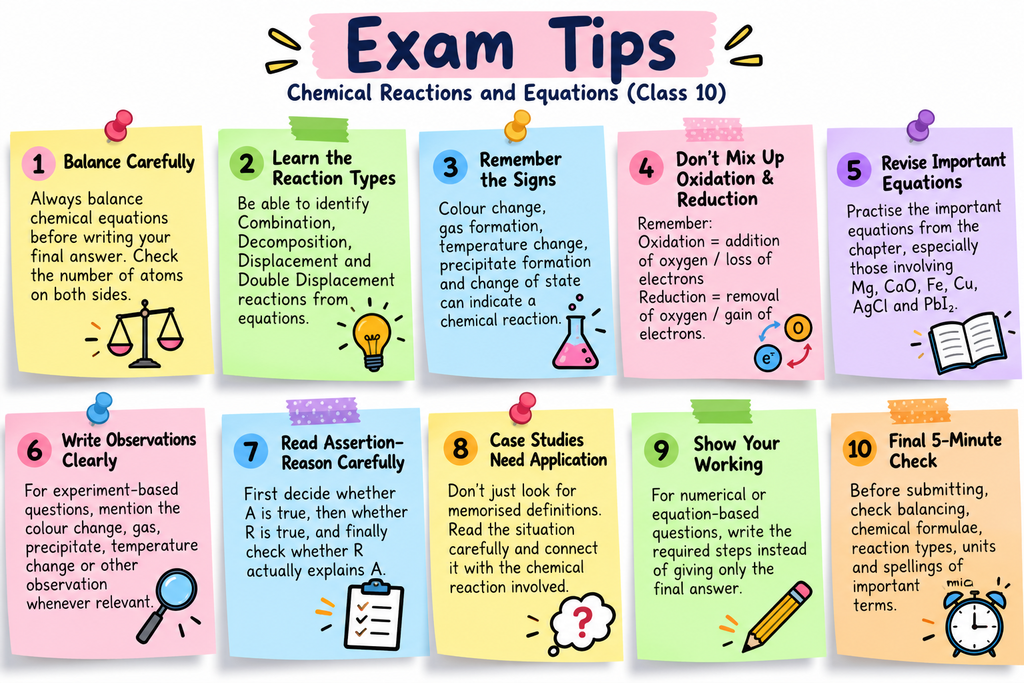
🌟 Stay calm, read carefully, and trust your preparation. A well-presented answer can make your knowledge much easier to evaluate.