This article provides NCERT Solutions and competency-based questions for Class 10 Science Chapter 1 – Chemical Reactions and Equations. The answers are explained in simple, student-friendly language to help you understand important concepts, practise application-based questions, and prepare effectively for the CBSE board examination.
📘 Need to revise the chapter first? Read our complete Chemical Reactions and Equations Class 10 notes before starting the NCERT solutions.
📚 Table of Contents
- NCERT Solutions for Class 10 Science Chapter 1
- Chemical Reactions and Equations – NCERT Exercise Solutions
- Competency-Based Questions
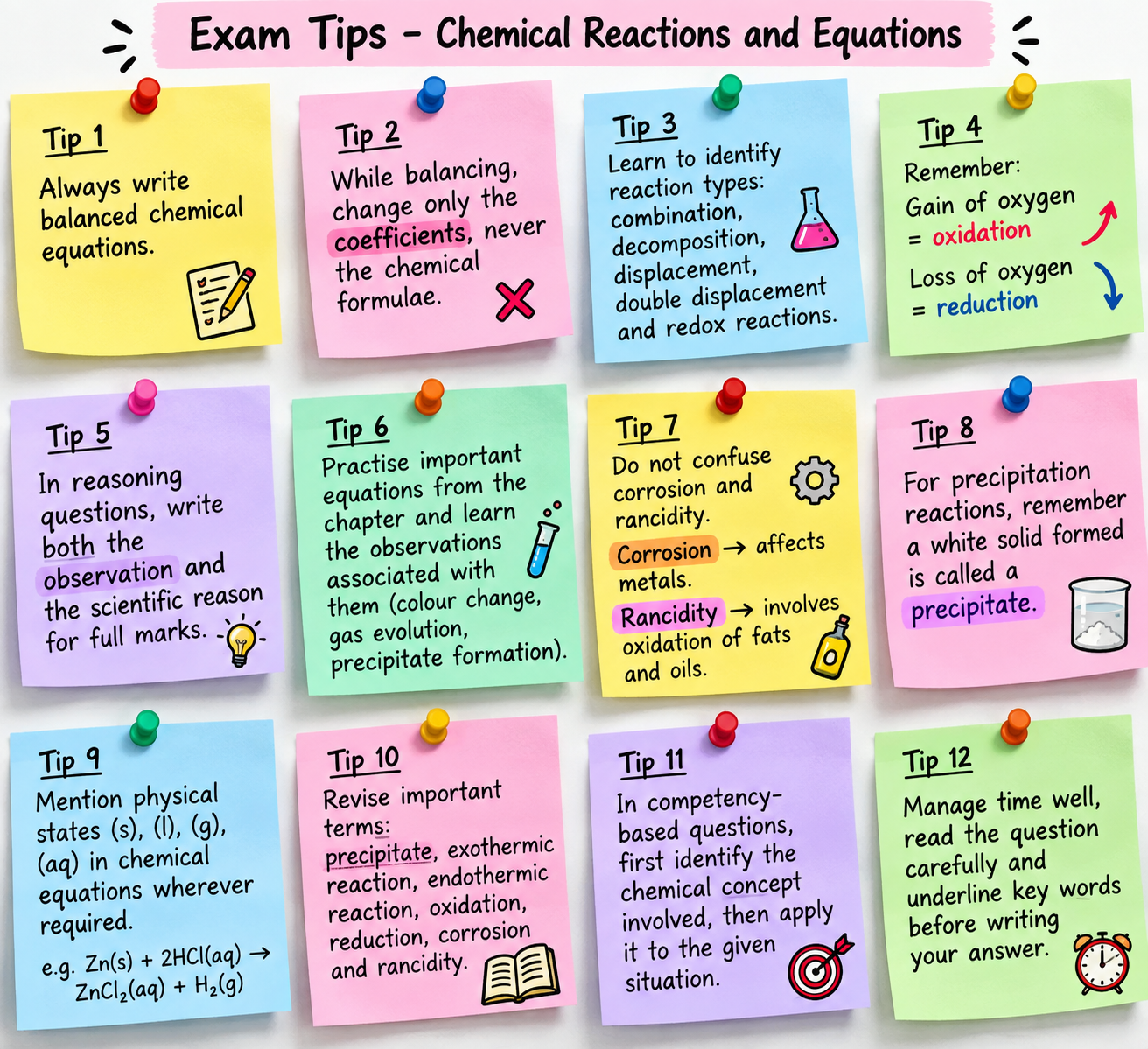
- Exam Tips – Chemical Reactions and Equations
- Practice Worksheet
- Official NCERT Textbook Reference
NCERT Solutions for Class 10 Science Chapter 1
In-Text Questions
Note:
The page numbers mentioned in these solutions are based on the NCERT Science Textbook for Class 10, 2026–27 edition. Page numbers may vary in other editions or reprints. Students can also identify the questions by their wording.
NCERT Solution Page 6
Question 1: Why should a magnesium ribbon be cleaned before burning in air?
Answer: Magnesium ribbon should be cleaned before burning because it forms a layer of magnesium oxide (MgO) when it comes in contact with oxygen present in the air. This layer prevents the magnesium ribbon from burning. Therefore, the magnesium ribbon should be cleaned before burning.
Question 2: Write the balanced equation for the following chemical reactions:
(i) Hydrogen + Chlorine → Hydrogen chloride
Skeleton equation:
H₂ + Cl₂ → HCl
Balanced equation:
H₂ + Cl₂ → 2HCl
(ii) Barium chloride + Aluminium sulphate → Barium sulphate + Aluminium chloride
Skeleton equation:
BaCl₂ + Al₂(SO₄)₃ → BaSO₄ + AlCl₃
Balanced equation:
3BaCl₂ + Al₂(SO₄)₃ → 3BaSO₄ + 2AlCl₃
(iii) Sodium + Water → Sodium hydroxide + Hydrogen
Skeleton equation:
Na + H₂O → NaOH + H₂
Balanced equation:
2Na + 2H₂O → 2NaOH + H₂
Question 3: Write a balanced chemical equation with state symbols for the following reactions:
(i) Solutions of barium chloride and sodium sulphate in water react to give insoluble barium sulphate and a solution of sodium chloride.
Skeleton equation:
BaCl₂ + Na₂SO₄ → BaSO₄ + NaCl
Balanced equation with state symbols:
BaCl₂(aq) + Na₂SO₄(aq) → BaSO₄(s) + 2NaCl(aq)
(ii) Sodium hydroxide solution (in water) reacts with hydrochloric acid solution (in water) to produce sodium chloride solution and water.
Skeleton equation:
NaOH + HCl → NaCl + H₂O
Balanced equation with state symbols:
NaOH(aq) + HCl(aq) → NaCl(aq) + H₂O(l)
NCERT Solution Page 10
Question 1: A solution of a substance ‘X’ is used for whitewashing.
(i) Name the substance ‘X’ and write its formula.
Answer: The substance ‘X’ is calcium oxide (quicklime), and its chemical formula is CaO.
(ii) Write the reaction of the substance ‘X’ named in (i) above with water.
Answer: The reaction of calcium oxide with water is:
CaO + H₂O → Ca(OH)₂ + Heat
This is a combination reaction and also an exothermic reaction
Question 2: Why is the amount of gas collected in one of the test tubes in Activity 1.7 double the amount collected in the other? Name this gas.
Answer: The amount of gas collected in one test tube is double the amount collected in the other because water decomposes into hydrogen and oxygen in the ratio 2:1.
2H₂O(l) → 2H₂(g) + O₂(g)
Therefore, the amount of hydrogen gas produced is twice the amount of oxygen gas. Hence, the gas collected in double the amount is Hydrogen.
Recall Activity 1.2
(i) What was the colour of the precipitate formed? Can you name the compound precipitated?
Answer: A yellow precipitate is formed. The precipitate is lead(II) iodide (PbI₂).
(ii) Write the balanced chemical equation for this reaction.
Answer:
Pb(NO₃)₂(aq) + 2KI(aq) → PbI₂(s) + 2KNO₃(aq)
(iii) Is this also a double displacement reaction?
Answer: Yes, it is a double displacement reaction because the ions of the two reactants exchange places to form two new compounds, lead(II) iodide and potassium nitrate.
Recall Activity 1.1
Question: Magnesium ribbon burns with a dazzling flame in air (oxygen) and changes into a white substance, magnesium oxide. Is magnesium being oxidised or reduced in this reaction?
Answer: Magnesium is being oxidised because it combines with oxygen to form magnesium oxide.
2Mg + O₂ → 2MgO
Since magnesium gains oxygen, it undergoes oxidation.
NCERT Solution Page 13
Question 1: Why does the colour of copper sulphate solution change when an iron nail is dipped in it?
Answer: Iron displaces copper from the copper sulphate solution because iron is more reactive than copper. As a result, the blue colour of copper sulphate solution changes to green due to the formation of iron sulphate.
Fe(s) + CuSO₄(aq) → FeSO₄(aq) + Cu(s)
This is a displacement reaction.
Question 2: Give an example of a double displacement reaction other than the one given in Activity 1.10.
Answer: An example of a double displacement reaction is the reaction between silver nitrate and sodium chloride.
AgNO₃(aq) + NaCl(aq) → AgCl(s) + NaNO₃(aq)
In this reaction, silver chloride (AgCl) is formed as a white precipitate. The ions of the two reactants exchange places; therefore, it is a double displacement reaction.
Question 3: Identify the substances that are oxidised and the substances that are reduced in the following reactions:
(i) 4Na(s) + O₂(g) → 2Na₂O(s)
Answer: Sodium (Na) is oxidised because it gains oxygen to form sodium oxide (Na₂O). Oxygen (O₂) is reduced.
(ii) CuO(s) + H₂(g) → Cu(s) + H₂O(l)
Answer: Copper oxide (CuO) is reduced because it loses oxygen to form copper (Cu). Hydrogen (H₂) is oxidised because it gains oxygen to form water (H₂O).
NCERT Exercises Questions Page 14
Question 1: Which of the statements about the reaction below are incorrect?
2PbO(s) + C(s) → 2Pb(s) + CO₂(g)
(a) Lead is getting reduced.
(b) Carbon dioxide is getting oxidised.
(c) Carbon is getting oxidised.
(d) Lead oxide is getting reduced.
(i) (a) and (b)
(ii) (a) and (c)
(iii) (a), (b) and (c)
(iv) all
Answer: (i) (a) and (b)
Explanation: In this reaction, lead oxide (PbO) loses oxygen and is reduced to lead (Pb), while carbon (C) gains oxygen and is oxidised to carbon dioxide (CO₂).
Therefore, statements (a) and (b) are incorrect.
Question 2:
Fe₂O₃ + 2Al → Al₂O₃ + 2Fe
The above reaction is an example of a:
(a) Combination reaction
(b) Double displacement reaction
(c) Decomposition reaction
(d) Displacement reaction
Answer: (d) Displacement reaction
Explanation: Aluminium is more reactive than iron, so it displaces iron from iron(III) oxide (Fe₂O₃) to form aluminium oxide (Al₂O₃) and iron (Fe).
Therefore, it is a displacement reaction.
Question 3: What happens when dilute hydrochloric acid is added to iron filings? Tick the correct answer.
(a) Hydrogen gas and iron chloride are produced.
(b) Chlorine gas and iron hydroxide are produced.
(c) No reaction takes place.
(d) Iron salt and water are produced.
Answer: (a) Hydrogen gas and iron chloride are produced.
Explanation: Iron displaces hydrogen from dilute hydrochloric acid, forming iron(II) chloride (FeCl₂) and hydrogen gas (H₂)
Fe(s) + 2HCl(aq) → FeCl₂(aq) + H₂(g) ↑
Therefore, the correct option is (a).
Question 4: What is a balanced chemical equation? Why should chemical equations be balanced?
Answer: A chemical equation in which the number of atoms of each element is equal on both the reactant and product sides is called a balanced chemical equation.
A chemical equation should be balanced to satisfy the law of conservation of mass, according to which mass can neither be created nor destroyed in a chemical reaction. Therefore, the total number of atoms of each element must remain the same before and after the reaction.
Question 5: Translate the following statements into chemical equations and then balance them:
(a) Hydrogen gas combines with nitrogen to form ammonia.
Skeleton equation:
H₂ + N₂ → NH₃
Balanced equation:
N₂ + 3H₂ → 2NH₃
(b) Carbon monoxide reacts with hydrogen under pressure to form methanol.
Skeleton equation:
CO + H₂ → CH₃OH
Balanced equation:
CO + 2H₂ → CH₃OH
(c) Ethanoic acid reacts with absolute ethanol in the presence of an acid catalyst to form an ester.
Skeleton equation:
CH₃COOH + C₂H₅OH → CH₃COOC₂H₅ + H₂O
Balanced equation:
CH₃COOH + C₂H₅OH → CH₃COOC₂H₅ + H₂O
It is already balanced in the ratio 1 : 1 : 1 : 1.
(d) Ethanoic acid reacts with sodium hydroxide to form sodium ethanoate and water.
Skeleton equation:
CH₃COOH + NaOH → CH₃COONa + H₂O
Balanced equation:
CH₃COOH + NaOH → CH₃COONa + H₂O
It is already balanced in the ratio 1 : 1 : 1 : 1.
Question 6: Balance the following chemical equations:
(a) HNO₃ + Ca(OH)₂ → Ca(NO₃)₂ + H₂O
Skeleton equation:
HNO₃ + Ca(OH)₂ → Ca(NO₃)₂ + H₂O
Balanced equation:
2HNO₃ + Ca(OH)₂ → Ca(NO₃)₂ + 2H₂O
(b) NaOH + H₂SO₄ → Na₂SO₄ + H₂O
Skeleton equation:
NaOH + H₂SO₄ → Na₂SO₄ + H₂O
Balanced equation:
2NaOH + H₂SO₄ → Na₂SO₄ + 2H₂O
(c) NaCl + AgNO₃ → AgCl + NaNO₃
Skeleton equation:
NaCl + AgNO₃ → AgCl + NaNO₃
Balanced equation:
NaCl + AgNO₃ → AgCl + NaNO₃
It is already balanced in the ratio 1 : 1 : 1 : 1.
(d) BaCl₂ + H₂SO₄ → BaSO₄ + HCl
Skeleton equation:
BaCl₂ + H₂SO₄ → BaSO₄ + HCl
Balanced equation:
BaCl₂ + H₂SO₄ → BaSO₄ + 2HCl
Question 7: Write the balanced chemical equations for the following reactions:
(a) Calcium hydroxide + Carbon dioxide → Calcium carbonate + Water
Skeleton equation:
Ca(OH)₂ + CO₂ → CaCO₃ + H₂O
Balanced equation:
Ca(OH)₂ + CO₂ → CaCO₃ + H₂O
It is already balanced in the ratio 1 : 1 : 1 : 1.
(b) Zinc + Silver nitrate → Zinc nitrate + Silver
Skeleton equation:
Zn + AgNO₃ → Zn(NO₃)₂ + Ag
Balanced equation:
Zn + 2AgNO₃ → Zn(NO₃)₂ + 2Ag
(c) Aluminium + Copper chloride → Aluminium chloride + Copper
Skeleton equation:
Al + CuCl₂ → AlCl₃ + Cu
Balanced equation:
2Al + 3CuCl₂ → 2AlCl₃ + 3Cu
(d) Barium chloride + Potassium sulphate → Barium sulphate + Potassium chloride
Skeleton equation:
BaCl₂ + K₂SO₄ → BaSO₄ + KCl
Balanced equation:
BaCl₂ + K₂SO₄ → BaSO₄ + 2KCl
Question 8: Write the balanced chemical equation for the following and identify the type of reaction in each case:
(a) Potassium bromide(aq) + Barium iodide(aq) → Potassium iodide(aq) + Barium bromide(s)
Balanced equation:
2KBr(aq) + BaI₂(aq) → 2KI(aq) + BaBr₂(s)
Type of reaction: Double displacement reaction.
(b) Zinc carbonate(s) → Zinc oxide(s) + Carbon dioxide(g)
Balanced equation:
ZnCO₃(s) → ZnO(s) + CO₂(g)
Type of reaction: Decomposition reaction — specifically, a thermal decomposition reaction because zinc carbonate decomposes on heating.
(c) Hydrogen(g) + Chlorine(g) → Hydrogen chloride(g)
Balanced equation:
H₂(g) + Cl₂(g) → 2HCl(g)
Type of reaction: Combination reaction.
(d) Magnesium(s) + Hydrochloric acid(aq) → Magnesium chloride(aq) + Hydrogen(g)
Balanced equation:
Mg(s) + 2HCl(aq) → MgCl₂(aq) + H₂(g)
Type of reaction: Displacement reaction.
Question 9: What does one mean by exothermic and endothermic reactions? Give examples.
Answer: An exothermic reaction is a chemical reaction in which heat is released.
Example:
CH₄ + 2O₂ → CO₂ + 2H₂O + Heat
An endothermic reaction is a chemical reaction in which heat is absorbed.
Example:
CaCO₃ + Heat → CaO + CO₂
Question 10: Why is respiration considered an exothermic reaction? Explain.
Answer: Respiration is considered an exothermic reaction because glucose reacts with oxygen in the cells of our body and releases energy.
C₆H₁₂O₆ + 6O₂ → 6CO₂ + 6H₂O + Energy
The energy released during respiration is used by the body to carry out various life processes.
Question 11: Why are decomposition reactions called the opposite of combination reactions? Write equations for these reactions.
Answer: Decomposition reactions are called the opposite of combination reactions because:
In a combination reaction, two or more substances combine to form a single product.
Example:
CaO + H₂O → Ca(OH)₂
In a decomposition reaction, a single compound breaks down into two or more simpler substances.
Example:
CaCO₃ + Heat → CaO + CO₂
Thus, the processes involved in combination and decomposition reactions are opposite to each other.
Question 12: Write one equation each for decomposition reactions where energy is supplied in the form of heat, light or electricity.
Answer:
1. Decomposition by heat (Thermal decomposition):
CaCO₃(s) + Heat → CaO(s) + CO₂(g)
2. Decomposition by light (Photochemical decomposition):
2AgCl(s) + Sunlight → 2Ag(s) + Cl₂(g)
3. Decomposition by electricity (Electrolytic decomposition):
2H₂O(l) + Electricity → 2H₂(g) + O₂(g)
Question 13 What is the difference between displacement and double displacement reactions? Write equations for these reactions.
Answer: In a displacement reaction, a more reactive element displaces a less reactive element from its compound.
Example:
Fe(s) + CuSO₄(aq) → FeSO₄(aq) + Cu(s)
In a double displacement reaction, two compounds exchange their ions to form two new compounds.
Example:
Na₂SO₄(aq) + BaCl₂(aq) → BaSO₄(s) + 2NaCl(aq)
Thus, in a displacement reaction one element is displaced, whereas in a double displacement reaction ions are exchanged between two compounds.
Question 14: In the refining of silver, the recovery of silver from silver nitrate solution involved displacement by copper metal. Write down the reaction involved.
Answer:
Copper is more reactive than silver, so it displaces silver from silver nitrate solution.
Reaction:
Cu(s) + 2AgNO₃(aq) → Cu(NO₃)₂(aq) + 2Ag(s)
This is a displacement reaction.
Question 15: What do you mean by a precipitation reaction? Explain by giving examples.
Answer:
A precipitation reaction is a reaction in which two aqueous solutions react to form an insoluble solid called a precipitate.
Example:
Na₂SO₄(aq) + BaCl₂(aq) → BaSO₄(s) ↓ + 2NaCl(aq)
Here, barium sulphate (BaSO₄) is an insoluble white precipitate.:
A precipitation reaction is a reaction in which two aqueous solutions react to form an insoluble solid called a precipitate.
Example:
Na₂SO₄(aq) + BaCl₂(aq) → BaSO₄(s) ↓ + 2NaCl(aq)
Here, barium sulphate (BaSO₄) is an insoluble white precipitate.
Question 16: Explain the following in terms of gain or loss of oxygen with two examples each:
(a) Oxidation (b) Reduction
Answer:
(a) Oxidation:
Oxidation is the gain of oxygen by a substance.
Examples:
2Cu + O₂ → 2CuO2Mg + O₂ → 2MgO
(b) Reduction:
Reduction is the loss of oxygen from a substance.
Examples:
CuO + H₂ → Cu + H₂OZnO + C → Zn + CO
Question 17: A shiny brown-coloured element ‘X’ on heating in air becomes black in colour. Name the element ‘X’ and the black-coloured compound formed.
Answer: The element X is copper (Cu).
When copper is heated in air, it reacts with oxygen and forms black copper(II) oxide (CuO).
Reaction:
2Cu + O₂ → 2CuO
Question 18: Why do we apply paint on iron articles?
Answer: We apply paint on iron articles to prevent rusting.
Paint forms a protective layer over the iron surface and prevents it from coming in contact with air and moisture, which are necessary for rusting.
Question 19: Oil and fat containing food items are flushed with nitrogen. Why?
Answer:
Oil and fat-containing food items are flushed with nitrogen gas to prevent rancidity.
Nitrogen is relatively unreactive and prevents the fats and oils from coming in contact with oxygen, thereby slowing down their oxidation and keeping the food fresh for a longer time.
Question 20: Explain the following terms with one example each:
(a) Corrosion
(b) Rancidity
Answer:
(a) Corrosion:
Corrosion is the gradual deterioration of a metal due to its reaction with substances such as oxygen, moisture, or acids present in the surroundings.
Example: Rusting of iron.
Iron reacts with oxygen and moisture to form rust (hydrated iron(III) oxide).
(b) Rancidity:
Rancidity is the process in which fats and oils get oxidised, resulting in an unpleasant smell and taste.
Example: Butter or fried food develops an unpleasant smell and taste when kept exposed to air for a long time.
Competency-Based Questions
1. A student observes bubbles when zinc is added to dilute hydrochloric acid. What does this observation suggest? Name the gas likely to be produced.
Answer: The formation of bubbles suggests that a gas is being produced during the chemical reaction.
When zinc reacts with dilute hydrochloric acid, hydrogen gas (H₂) is produced.
Equation:
Zn(s) + 2HCl(aq) → ZnCl₂(aq) + H₂(g) ↑
Therefore, the bubbles observed are of hydrogen gas.
2. A student balances an equation by changing H₂O into H₂O₂. Explain why this method is incorrect.
Answer: This method is incorrect because while balancing a chemical equation, we can change only the coefficients in front of the chemical formulae, not the formulae themselves.
Changing H₂O into H₂O₂ changes the substance itself: H₂O is water, whereas H₂O₂ is hydrogen peroxide.
Therefore, a chemical equation must be balanced by adjusting coefficients without changing the chemical formulae of the reactants or products.
3. A white solid appears when two colourless solutions are mixed. What type of reaction may have occurred? What is the white solid called?
Answer: A double displacement reaction may have occurred in which an insoluble substance is formed. Such a reaction is called a precipitation reaction.
The white solid formed is called a precipitate.
4. An iron nail is placed in copper sulphate solution. After some time, a change is observed. Explain why this can be considered a displacement reaction.
Answer: Iron is more reactive than copper, so it displaces copper from copper sulphate solution.
Reaction:
Fe(s) + CuSO₄(aq) → FeSO₄(aq) + Cu(s)
The blue copper sulphate solution gradually turns green, and a reddish-brown deposit of copper forms on the iron nail.
Therefore, it is a displacement reaction because iron displaces copper from its compound.
5. Two identical iron objects are kept under different conditions. One is kept dry, while the other is exposed to moist air. Which one is expected to rust faster? Give a reason.
Answer: The iron object exposed to moist air is expected to rust faster.
This is because rusting of iron requires both oxygen and moisture (water). The dry iron object has little or no moisture available, so rusting occurs much more slowly.
6. A packet of oily food is opened after several weeks and has an unpleasant smell. Which chemical process is responsible? Suggest two ways of slowing this process.
Answer: The chemical process responsible for the unpleasant smell is rancidity. It occurs when fats and oils in food get oxidised on exposure to air.
Two ways to slow down rancidity are:
- Store the food in an airtight container to reduce contact with oxygen.
- Keep the food refrigerated to slow down the oxidation process.
📝 Want more practice? Strengthen your preparation with our 21-page Class 10 Chemical Reactions and Equations Worksheet Pack, including MCQs, competency-based questions, balancing equations, assertion–reason questions and a complete answer key.
📚 For the official textbook, visit the NCERT Class 10 Science textbook page.