Introduction
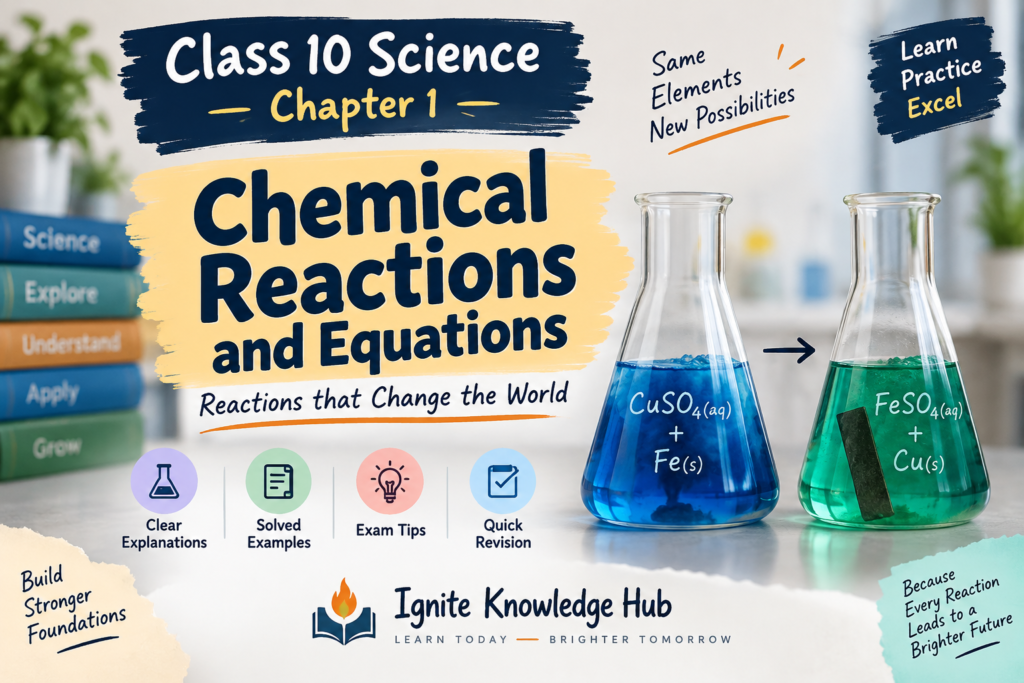
In this Chemical Reactions and Equations Class 10 chapter, we will explore how chemical reactions occur and how they are represented using chemical equations.
Have you ever noticed what happens to a freshly cut apple if you leave it exposed to air for a few minutes? It gradually turns brownish. What happens when milk is left at room temperature during a hot summer day? It sours and turns into curd. Think about the burning of cooking gas (LPG) in your kitchen, the digestion of food inside your body, or the rusting of an iron nail left outside in humid weather.
All these changes involve chemical reactions. In a chemical reaction, the original substances change into completely new substances with different properties. Chemistry is not just something that happens in a lab — it happens in your kitchen, in your body, and all around you.
In this chapter, we will learn how to identify chemical reactions and how to write them in a simple, scientific language called a chemical equation.
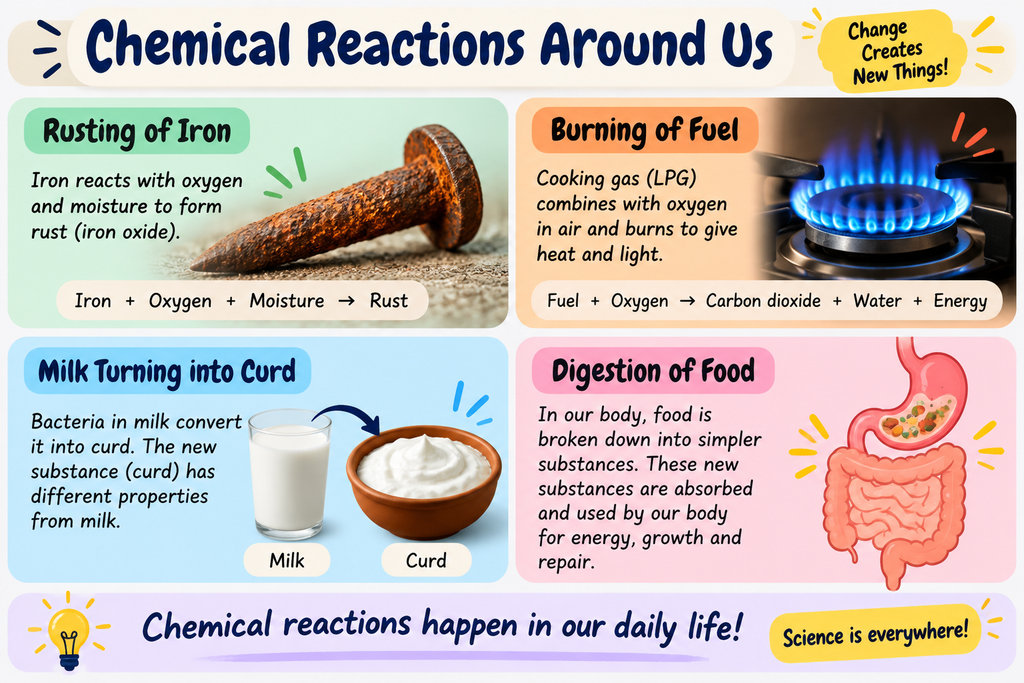
Table of content
and Equations
What is a Chemical Reaction?
A chemical reaction is a process in which one or more substances change into new substances with different properties.
The substances that take part in a reaction are called reactants, while the new substances formed are called products.
For example, when magnesium burns in air,
Magnesium + Oxygen → Magnesium oxide
Here:
- Magnesium and oxygen are the reactants.
- Magnesium oxide is the product.
What Happens When a Chemical Reaction Takes Place?
When a chemical reaction takes place, chemical bonds between atoms in the reactants break, and new bonds form to create the products. Atoms are neither created nor destroyed; they simply rearrange themselves.
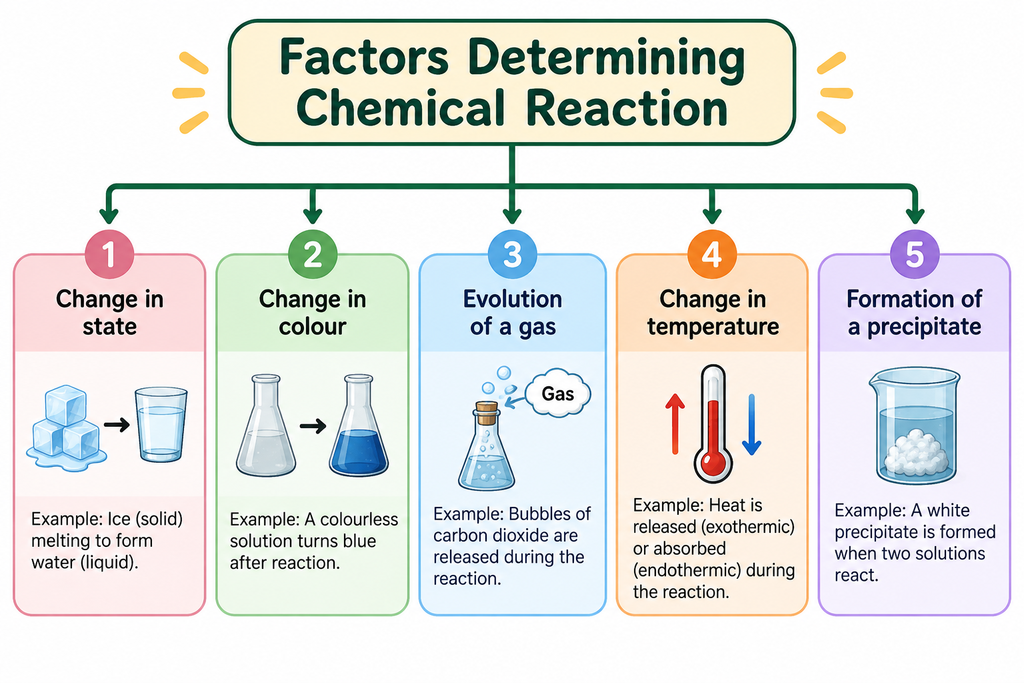
How Can We Tell That a Chemical Reaction Has Taken Place?
- Change in state
A substance may change from one physical state to another as part of a chemical reaction. A solid may form from two liquids. For example, when we mix two clear solutions, a solid precipitate can appear.
2. Change in colour
A noticeable colour change can indicate the formation of a new substance. For example,When iron rusts, its shiny grey colour changes to reddish-brown.
3. Evolution of a gas
Some reactions produce a gas. For example, when zinc reacts with dilute hydrochloric acid, hydrogen gas is released.
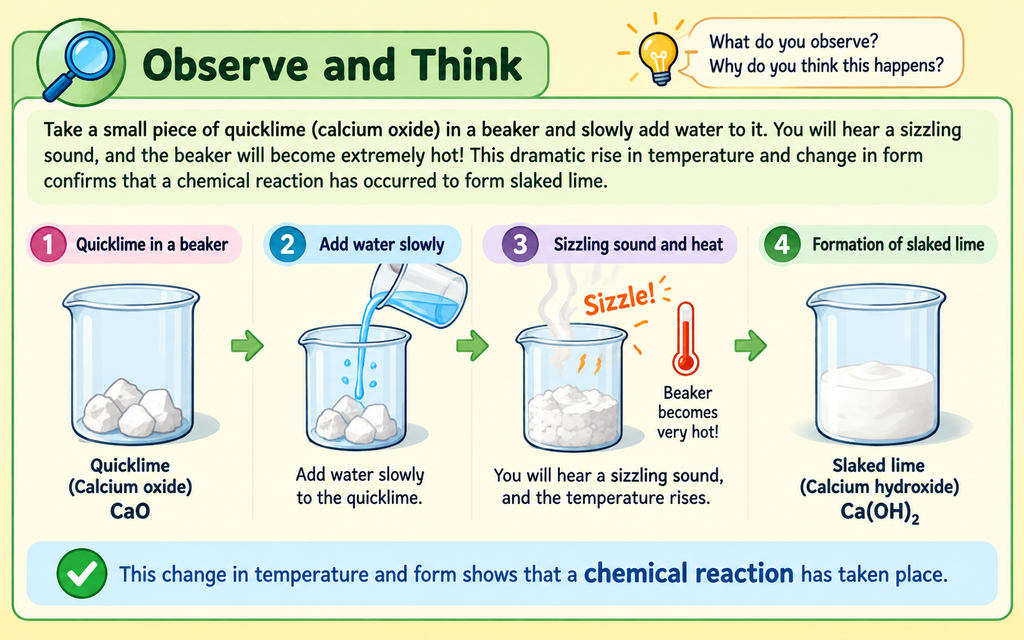
4. Change in temperature
Some reactions release heat, while others absorb heat. A temperature change can therefore be an indication of a chemical reaction. For example, When quicklime is added to water, the beaker becomes hot. The temperature changes.
5. Formation of a precipitate
Sometimes two solutions react and produce a precipitate. A precipitate is an insoluble solid that settles down from a solution.
💡 Did You Know?
Chemical Equations
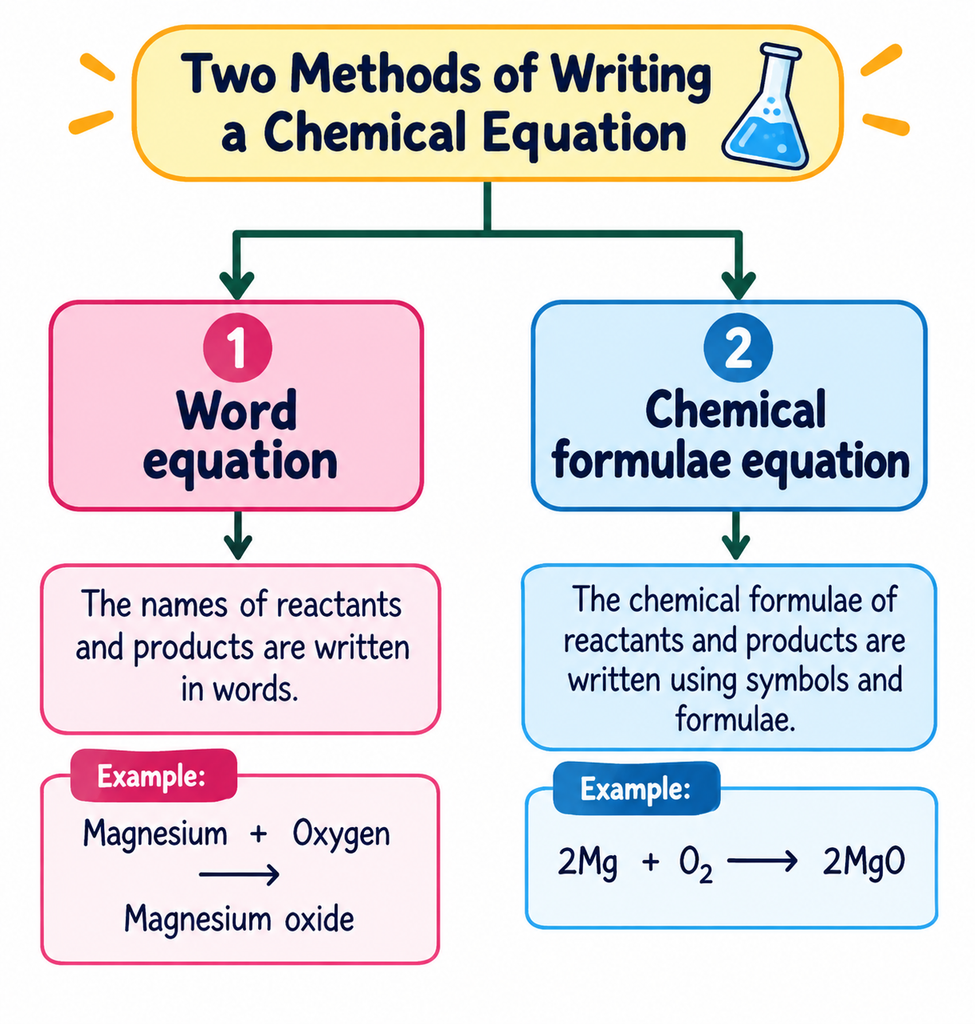
Writing a chemical reaction in words is useful, but it can become lengthy. Chemistry therefore uses chemical equations to represent reactions in a short and convenient form. A chemical equation is the symbolic representation of a chemical reaction.
Do Yourself
- Consider the reaction between Hydrogen and oxygen.Write the word equation and indicate reactants and product .
- Consider the reaction between Sodium and Chlorine.Write the word equation and indicate reactants and product.
Balanced Chemical Equations
Look closely at the chemical equation for burning magnesium:
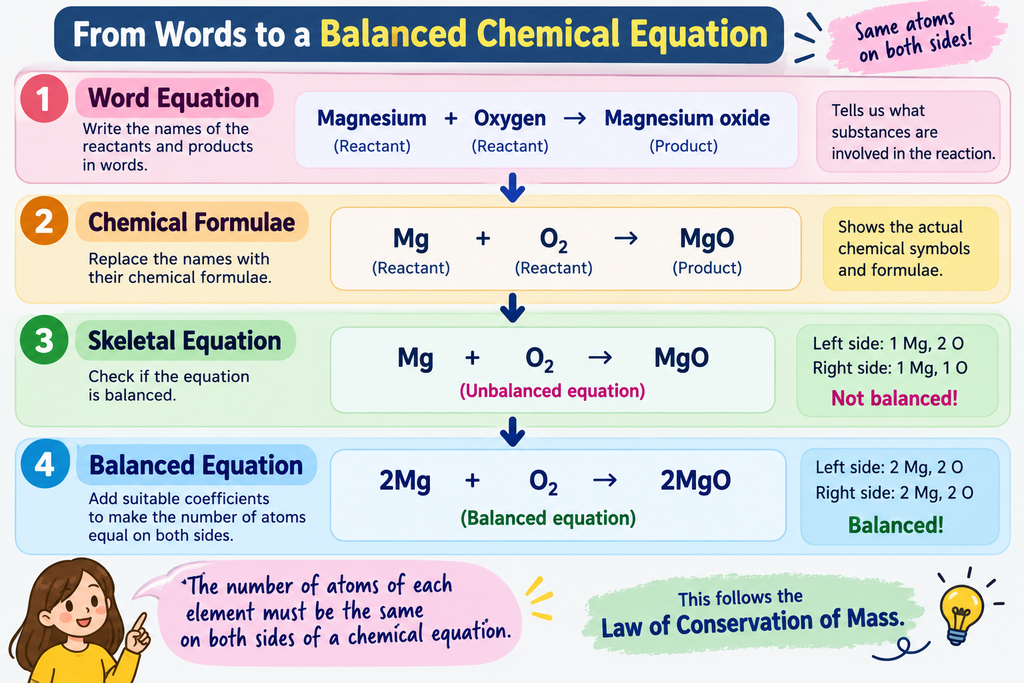
Mg + O₂ → MgO
Count the atoms on both sides:
- Left Side (Reactants): 1 Magnesium atom, 2 Oxygen atoms
- Right Side (Products): 1 Magnesium atom, 1 Oxygen atom
Where did the second oxygen atom go? It cannot simply vanish!
The Law of Conservation of Mass
Why do we need to balance a chemical equation?
The answer comes from the Law of Conservation of Mass. Matter is neither created nor destroyed during a chemical reaction. Therefore, the number of atoms of each element must be the same on both sides of a chemical equation.
An equation where the number of atoms on both sides is not equal is called an unbalanced or skeletal equation.
A balanced chemical equation is the one in which the total number of atoms of each element is equal on both sides of the equation.
Mg + O₂ → MgO (unbalanced/ skeleton equation)
2Mg + O₂ → 2MgO (Balanced equation)
Balancing of a Chemical Equation
The method used for balancing a chemical equation is called the hit-and-trial method. In this method, we try different coefficients until the number of atoms of each element becomes equal on both sides of the equation. We use the smallest possible whole-number coefficients while balancing the equation. Let us understand the process of balancing a chemical equation step by step.
Example 1.
Balance the following chemical equation:
H₂ + O₂ → H₂O
Let us examine the number of atoms of different elements on both sides of the arrow.
| Elements | Number of Atoms in Reactants (LHS) | Number of Atoms in Products(RHS) |
|---|---|---|
| H | 2 | 2 |
| O | 2 | 1 |
Oxygen is not balanced. We can balance the equation by changing the coefficients, not the chemical formulae.
First, place the coefficient 2 before water. The equation becomes:
H₂ + O₂ → 2H₂O
Now, count the number of atoms of each element on both sides of the equation.
| Elements | Number of Atoms in Reactants (LHS) | Number of Atoms in Products (RHS) |
|---|---|---|
| H | 2 | 4 |
| O | 2 | 2 |
From the table, it is clear that there are 4 hydrogen atoms on the product side but only 2 hydrogen atoms on the reactant side. Therefore, we place the coefficient 2 before H₂ on the reactant side. The number of oxygen atoms is already equal on both sides, so we do not change its coefficient. We get:
2H₂ + O₂ → 2H₂O
Now, compare the number of atoms of each element on both sides of the equation. We get:
| Elements | Number of Atoms in Reactants (LHS) | Number of Atoms in Products (RHS) |
|---|---|---|
| H | 4 | 4 |
| O | 2 | 2 |
Thus, the balanced chemical equation is:
2H₂ + O₂ → 2H₂O
Now, the number of hydrogen and oxygen atoms is equal on both sides of the equation. Therefore, the equation is balanced and follows the Law of Conservation of Mass.
⚠️ Common Mistake
Never change the chemical formula of a substance to balance an equation. For example, do not change H₂O to H₃O.
You can change only the coefficients (numbers written before chemical formulae). The chemical formula of a substance remains unchanged.
Example from NCERT:
Balance the following chemical equation:
Fe + H₂O → Fe₃O₄ + H₂ (Iron reacts with steam)
Let us examine the number of atoms of different elements on both sides of the arrow.
| Elements | Number of Atoms in Reactants (LHS) | Number of Atoms in Products (RHS) |
|---|---|---|
| Fe | 1 | 3 |
| H | 2 | 2 |
| O | 1 | 4 |
- Start with the compound, Fe₃O₄. To balance Fe, put 3 before Fe on the left. The chemical equation becomes,
3Fe + H₂O → Fe₃O₄ + H₂
| Elements | Number of Atoms in Reactants (LHS) | Number of Atoms in Products (RHS) |
|---|---|---|
| Fe | 3 | 3 |
| H | 2 | 2 |
| O | 1 | 4 |
2. Now balance O. There are 4 O on the right, so put 4 before H₂O on the left.
3Fe + 4H₂O → Fe₃O₄ + H₂
3. Now balance H. Left side has 4 × 2 = 8 H. So put 4 before H₂ on the right.
3Fe + 4H₂O → Fe₃O₄ + 4H₂
Now, compare the number of atoms of each element on both sides of the equation. We get:
| Elements | Number of Atoms in Reactants (LHS) | Number of Atoms in Products (RHS) |
|---|---|---|
| Fe | 3 | 3 |
| H | 8 | 8 |
| O | 4 | 4 |
Now, the number of iron, hydrogen, and oxygen atoms is equal on both sides of the equation. Therefore,
3Fe + 4H₂O → Fe₃O₄ + 4H₂
is a balanced chemical equation and obeys the Law of Conservation of Mass.
You do not need to make such a table and compare the number of atoms of each element every time you balance a chemical equation. This table is used here only to help you understand the balancing method clearly.
State symbols
Chemical equations can also show the physical state of substances:
- (s) – solid
- (l) – liquid
- (g) – gas
- (aq) – aqueous solution, meaning dissolved in water
For example:
2H₂(g) + O₂(g) → 2H₂O(l)
- Reaction conditions like temperature, pressure, or catalysts are written above or below the arrow:
For example,
CO(g) + 2H₂(g) 340 atm → CH₃OH(l)
📝 Exam Tip– Balancing Chemical Equations
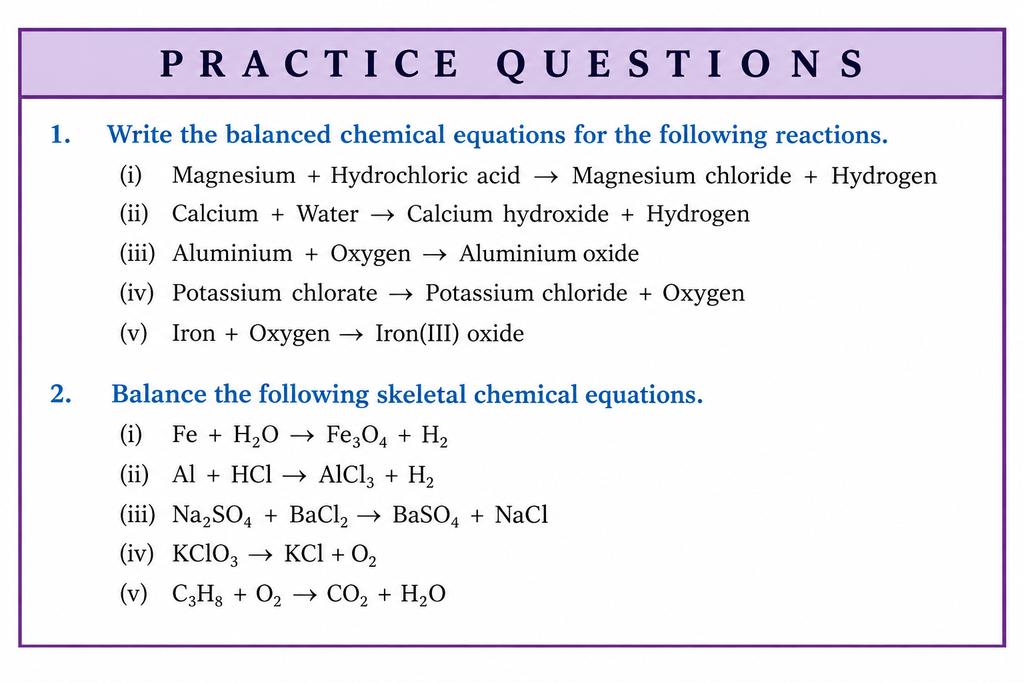
- First write the correct skeletal chemical equation.
- Balance the equation step by step rather than trying to balance all the elements at once.
- Never change the chemical formulae of reactants or products. Change only the coefficients.
- Prefer balancing more complex substances first and hydrogen and oxygen towards the end, when convenient.
- Count the atoms again after balancing to make sure each element has the same number of atoms on both sides.
- Add state symbols — (s), (l), (g), and (aq) — if the question asks for a complete balanced chemical equation.
- Write any required reaction conditions such as heat, light, temperature, or catalyst over or near the reaction arrow.
- In the exam, show the important balancing steps if the question specifically asks you to balance an equation rather than giving only the final answer.
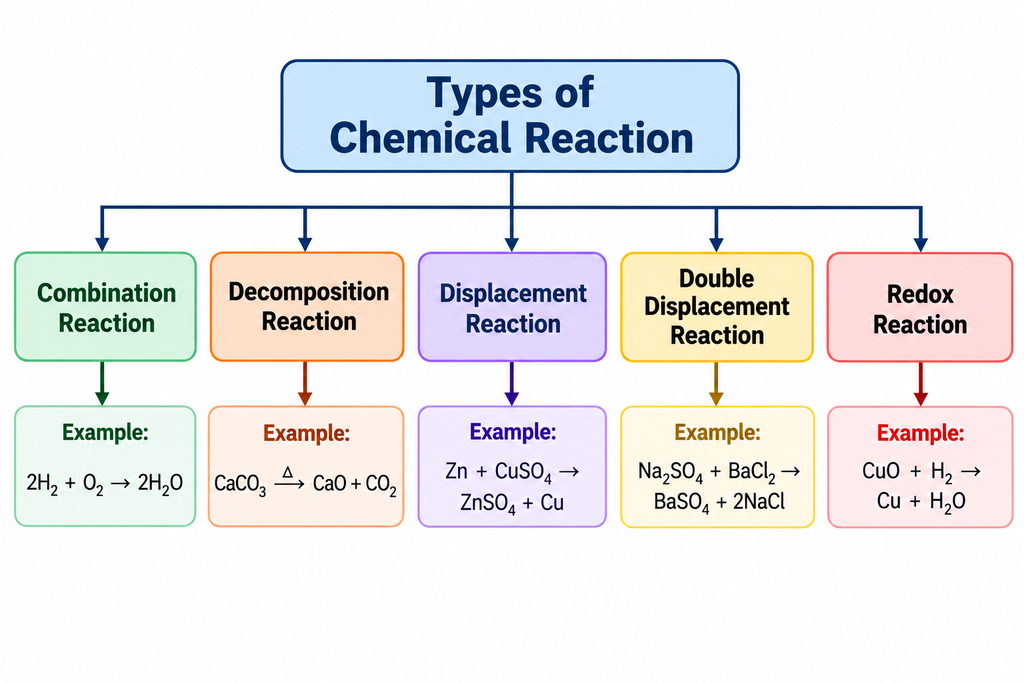
Types of Chemical Reactions
Chemical reactions can be classified according to how reactants change into products.
1. Combination Reaction
A reaction in which two or more substances combine to form a single product is called a combination reaction.
Example
Calcium oxide reacts with water to form calcium hydroxide.
Some more examples of Combination reaction are:
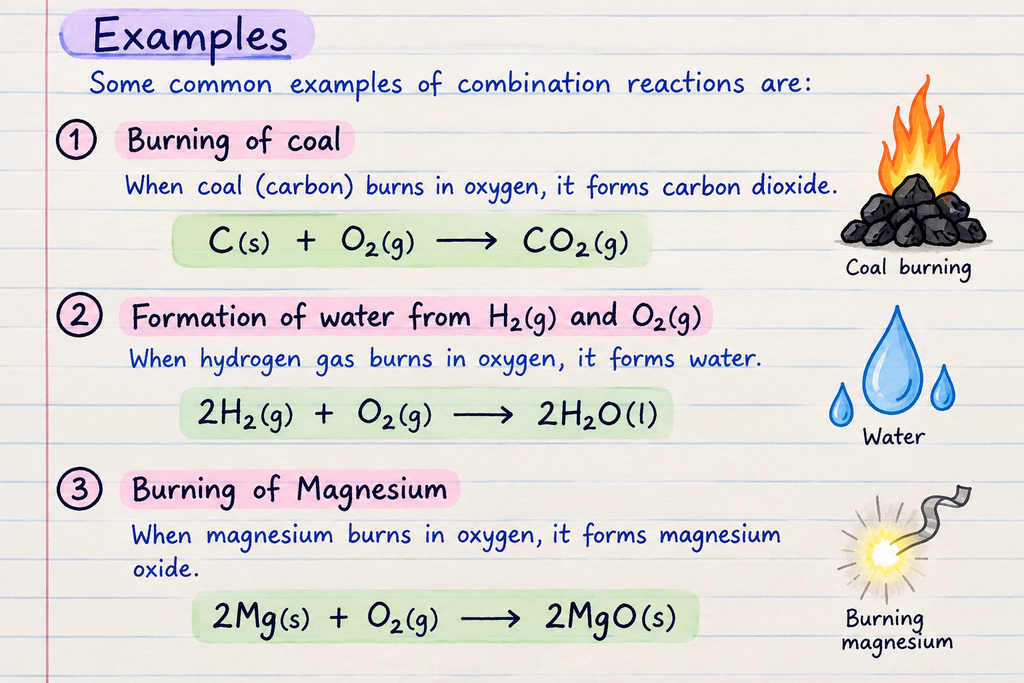
In all the above examples, two reactants combine to form one product. The number of reactants may be two, three, or even more, but only one product is formed.
📝 Exam Tip
Slaked lime, Ca(OH)₂, when applied to walls, slowly reacts with CO₂ from air to form CaCO₃, which gives the shiny white finish. That’s why whitewash looks shiny after 2-3 days.
2. Decomposition Reaction
A reaction in which a single reactant breaks down into two or more simpler products. This is the exact opposite of a combination reaction.
Example
Calcium carbonate breaks down into calcium oxide and carbon dioxide when heated.
The decomposition reactions require energy eitherin the form of heat, light or electricity for breaking down the reactants.
- Thermal Decomposition(Heat Energy)
When decomposition takes place because of heat, it is called thermal decomposition.
Example:
2FeSO₄(s) → Fe₂O₃(s) + SO₂(g) + SO₃(g)
This reaction occurs on heating.
- Electrolytic Decomposition(Electrical Energy)
Some compounds can be decomposed using electricity.
For example, water can be decomposed into hydrogen and oxygen by electrolysis:
2H₂O(l) → 2H₂(g) + O₂(g)
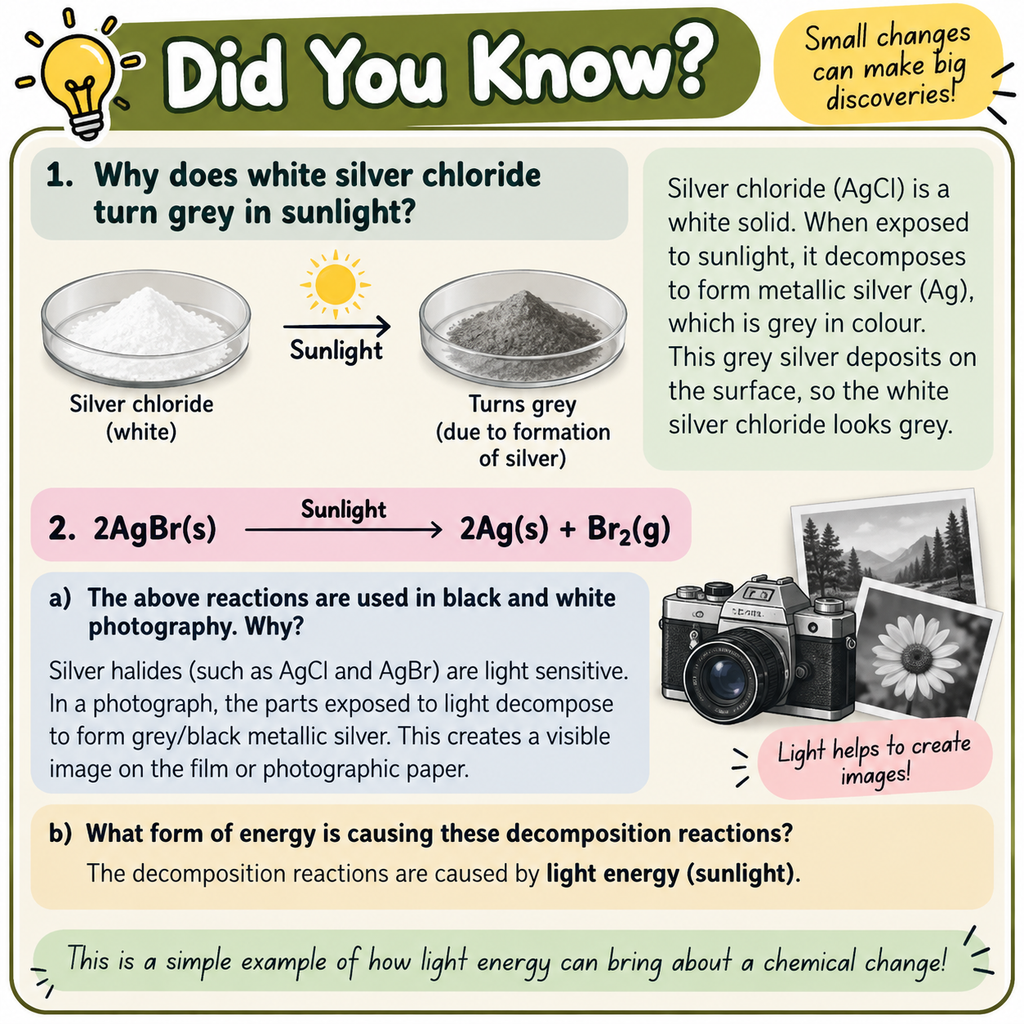
- Photochemical Decomposition(Light energy)
Some compounds decompose in the presence of light.
For example, silver chloride decomposes in sunlight:
This reaction is one reason silver chloride is sensitive to light.
(White silver chloride turns grey in sunlight. This reaction is used in black and white photography.)
Similarly,
3. Displacement Reaction
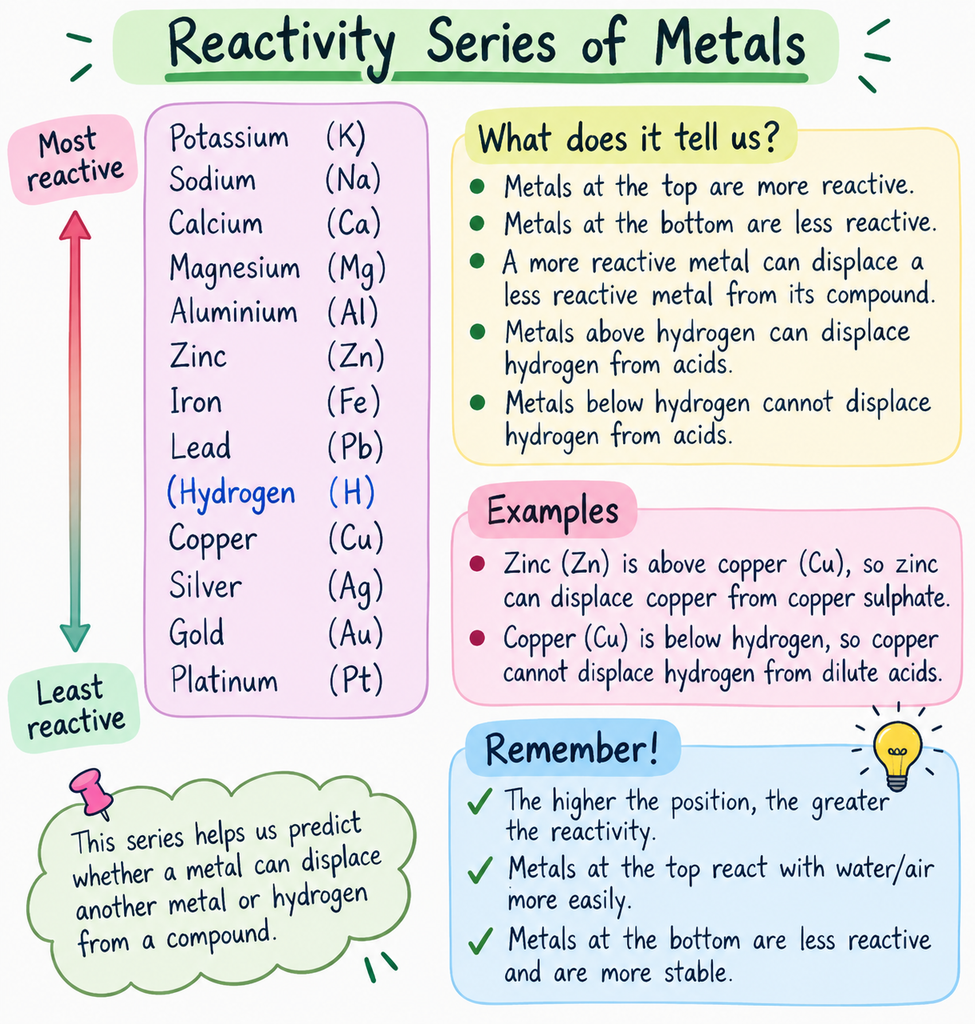
A reaction in which a more reactive element displaces a less reactive element from its compound is called a displacement reaction.
Example:
When an iron nail is placed in copper sulphate solution:
Fe(s) + CuSO₄(aq) → FeSO₄(aq) + Cu(s)
The blue colour of copper sulphate fades and a reddish-brown coating of copper forms on the iron nail. This happens because iron is more reactive than copper.
Let us understand with some more examples:
Example 1.
Zn + CuSO₄ → ZnSO₄ + Cu
Zinc is more reactive than copper, so zinc displaces copper from copper sulphate.
The blue colour of copper sulphate solution fades as copper ions are displaced and colourless zinc sulphate is formed.
Example 2.
When an iron nail is dipped into a blue copper sulphate solution, iron displaces copper. The blue colour fades to light green, and a reddish-brown coating of copper forms on the nail.
Fe(s) + CuSO4(aq) → FeSO4(aq) + Cu(s)
4. Double Displacement Reaction
A reaction in which two compounds exchange ions to form two new compounds is called a double displacement reaction.
Example:
Mixing sodium sulphate and barium chloride:
Na₂SO₄(aq) + BaCl₂(aq) → BaSO₄(s) + 2NaCl(aq)
Here, the ions exchange partners. A white insoluble substance, barium sulphate, is formed.
If one of the products formed is an insoluble solid, it is called a precipitate. The reaction is then also called a precipitation reaction. In the above example, BaSO₄ is a white precipitate.
Precipitation Reaction
When a chemical reaction produces an insoluble solid called a precipitate, it is called a precipitation reaction.
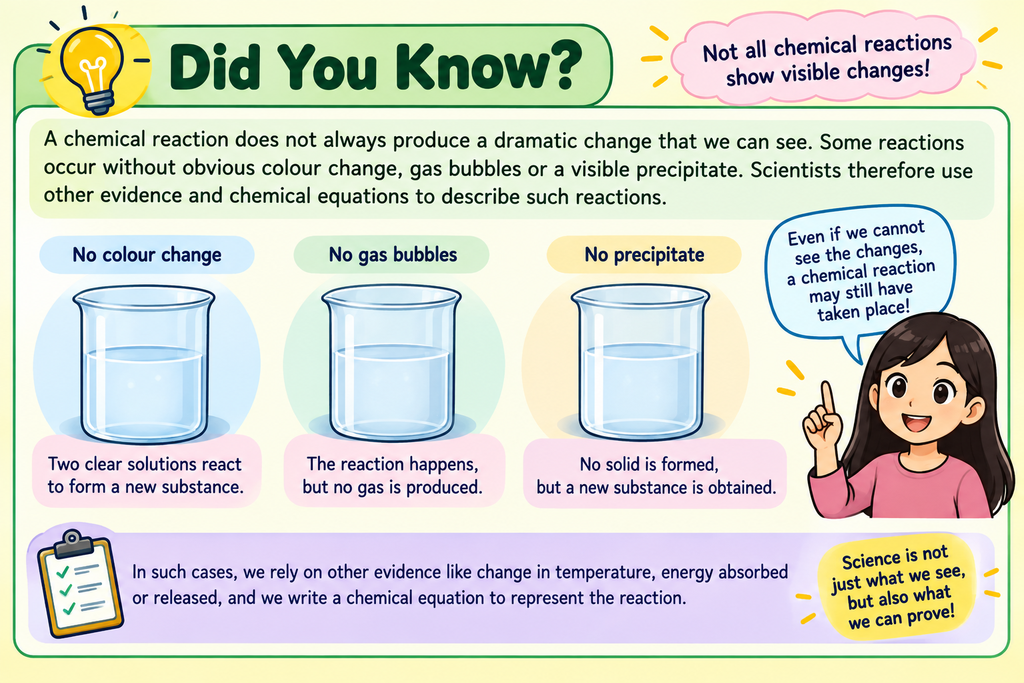
Did You Know?
Barium sulphate (BaSO₄) is used as a contrast agent in X-ray imaging of the digestive tract. It is suitable for this purpose because it is insoluble in water and is not significantly absorbed by the body.
Exothermic and Endothermic Reactions
A reaction that releases heat to its surroundings is called an exothermic reaction. The reaction mixture becomes hot.
A reaction that absorbs energy from its surroundings is called an endothermic reaction. The reaction mixture becomes cold.
| Exothermic Reaction | Endothermic Reaction |
|---|---|
| A reaction that releases heat energy to the surroundings is called an exothermic reaction. | A reaction that absorbs heat energy from the surroundings is called an endothermic reaction. |
| The surroundings or reaction mixture generally become warmer. | The surroundings or reaction mixture generally become cooler when heat is absorbed from them. |
| Reactants ⟶ Products + Heat | Reactants + Heat ⟶ Products |
|
Burning of natural gas: CH₄ + 2O₂ ⟶ CO₂ + 2H₂O + Heat |
Thermal decomposition of calcium carbonate: CaCO₃ ⟶ CaO + CO₂ (on heating) |
|
Respiration: C₆H₁₂O₆ + 6O₂ ⟶ 6CO₂ + 6H₂O + Energy |
Photosynthesis: 6CO₂ + 6H₂O ⟶ C₆H₁₂O₆ + 6O₂ (in the presence of sunlight) |
| Many combustion reactions are exothermic. | Many thermal decomposition reactions require absorption of heat. |
| Remember: Heat is released. | Remember: Heat is absorbed. |
Oxidation and Reduction (Redox Reactions)
Oxidation and reduction reactions always happen hand-in-hand!
| Oxidation Reaction | Reduction Reaction |
|---|---|
| A reaction in which a substance gains oxygen or loses hydrogen is called an oxidation reaction. | A reaction in which a substance loses oxygen or gains hydrogen is called a reduction reaction. |
| Gain of oxygen → Oxidation | Loss of oxygen → Reduction |
| Loss of hydrogen → Oxidation | Gain of hydrogen → Reduction |
|
Example 1: 2Cu + O₂ ⟶ 2CuO Copper gains oxygen and is oxidized. |
Example 1: CuO + H₂ ⟶ Cu + H₂O Copper oxide loses oxygen and is reduced. |
|
Example 2: C + O₂ ⟶ CO₂ Carbon gains oxygen and is oxidized. |
Example 2: ZnO + C ⟶ Zn + CO Zinc oxide loses oxygen and is reduced. |
| Remember: Oxidation = Gain of oxygen or loss of hydrogen. | Remember: Reduction = Loss of oxygen or gain of hydrogen. |
What is a Redox Reaction?
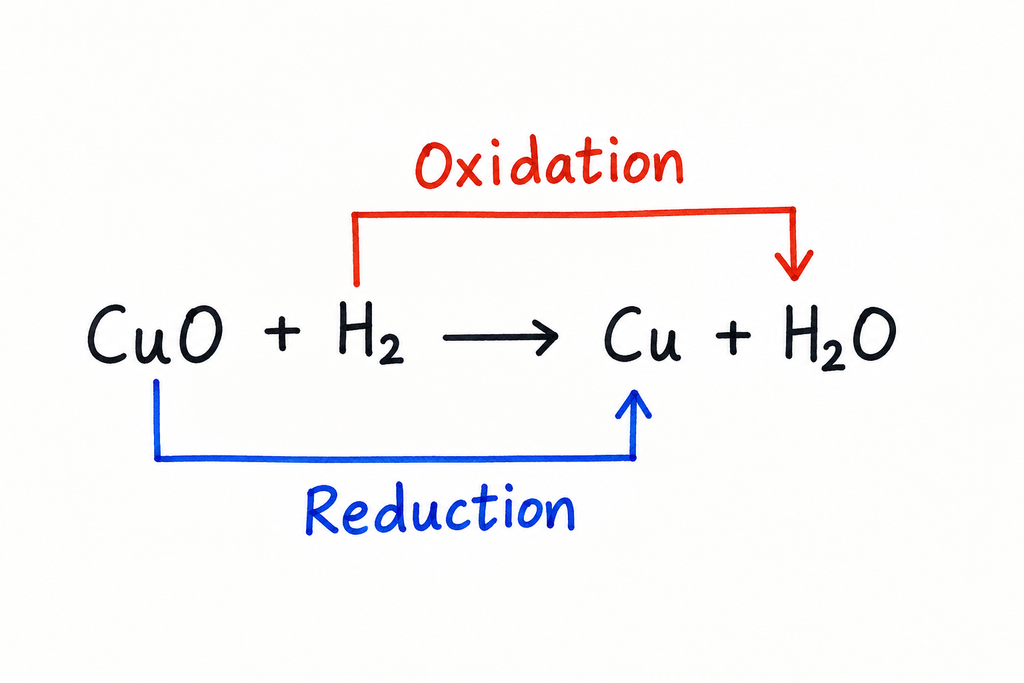
A chemical reaction in which oxidation and reduction take place simultaneously is called a redox reaction.
CuO + H₂ ⟶ Cu + H₂O
Here:
CuO ⟶ Cu → Loss of oxygen → Reduction
H₂ ⟶ H₂O → Gain of oxygen → Oxidation
📝 Exam Tip
Remember: oxidation and reduction occur together in a redox reaction. If one substance is oxidised, another substance is reduced.
Effects of Oxidation in Everyday Life
Oxidation is not limited to reactions performed in a laboratory. It also causes several changes in everyday life.
Corrosion
When a metal surface is attacked by substances around it such as moisture, air, or acids, it slowly corrodes. This process is called corrosion
The most common example is rusting of iron. When iron is exposed to moist air for a long time:
4Fe(s) + 3O₂(g) + 2xH₂O(l) → 2Fe₂O₃·xH₂O (rust)
Rust is a reddish-brown flaky powder. It makes iron weak.
Other examples of corrosion are:
- Black Coating on Silver: Silver reacts with sulphur in the air to form silver sulphide.
2Ag(s) + S(s) ⟶ Ag₂S(s)
- Green Coating on Copper: Copper reacts with moist carbon dioxide to form basic copper carbonate.
2Cu(s) + O₂(g) + CO₂(g) + H₂O(l) ⟶ CuCO₃·Cu(OH)₂(s)
Methods to Prevent Corrosion:
Corrosion can be reduced by preventing the metal from coming into contact with air and moisture.
Common methods include:
- Painting
- Oiling or greasing
- Galvanisation—coating iron or steel with zinc
- electroplating and Alloying —using suitable alloys that resist corrosion
For example, stainless steel is more resistant to corrosion than ordinary iron.
Rancidity
Have you ever noticed that an old packet of chips or oily food develops an unpleasant smell and taste?This happens because fats and oils can undergo oxidation.
The spoilage of food containing fats and oils due to oxidation is called rancidity.
Practice Chemical Reactions and Equations
Ready to test your understanding? Practice this chapter with our 21-page printable worksheet pack featuring MCQs, competency-based questions, balancing chemical equations, reaction identification, assertion–reason questions, and a complete answer key.
👉 Get the Class 10 Chemical Reactions & Equations Worksheet Pack
📘 Looking for textbook answers? Explore our NCERT Solutions & Competency-Based Questions for Class 10 Science Chapter 1.
Key Takeaways
- A chemical reaction produces one or more new substances.
- Substances taking part in a reaction are called reactants; substances formed are products.
- Change in colour, state, temperature or evolution of gas may indicate a chemical reaction.
- Chemical equations represent reactions using chemical formulae and symbols.
- A chemical equation must be balanced according to the Law of Conservation of Mass.
- Major reaction types include combination, decomposition, displacement and double displacement reactions.
- Exothermic reactions release heat, whereas endothermic reactions absorb heat.
- Oxidation and reduction occur together in redox reactions.
- Corrosion is the gradual deterioration of metals due to environmental reactions.
- Rancidity is caused by oxidation of fats and oils and can be reduced by limiting exposure to oxygen.
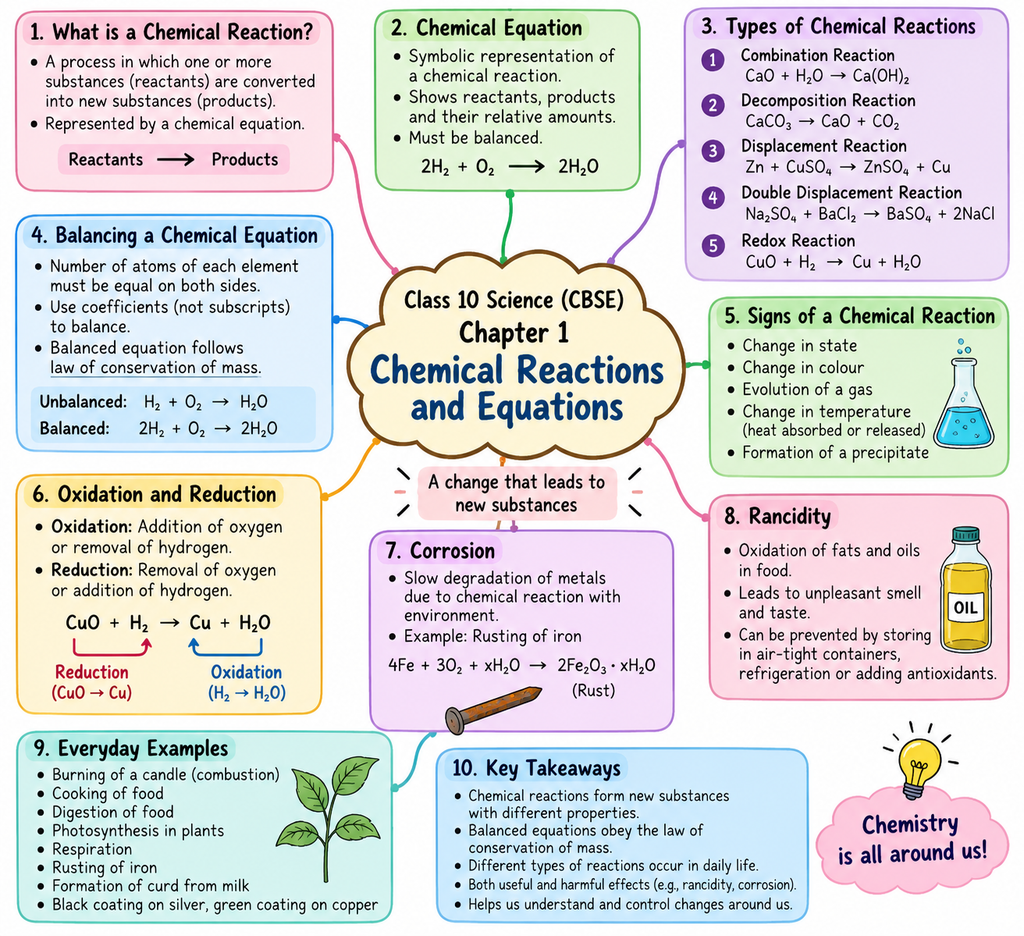
Mind map