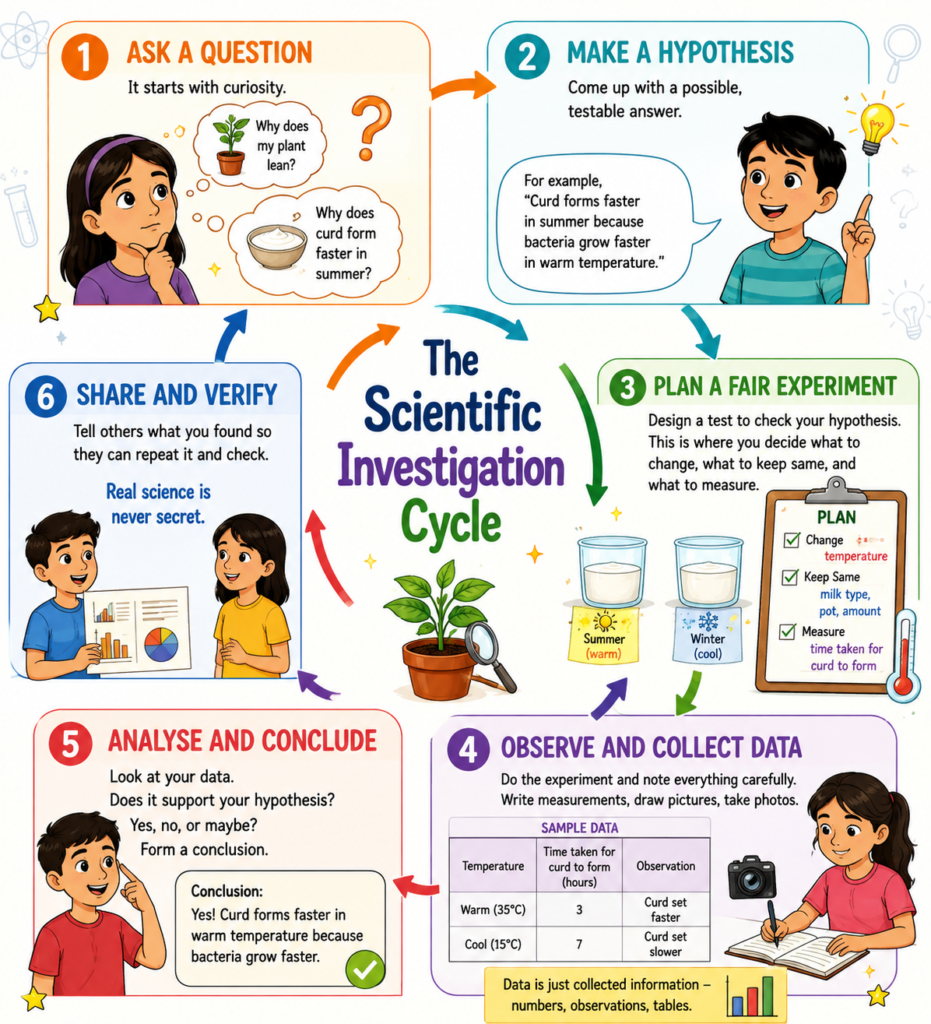
Introduction: Science Begins with a Curious “Why?”
Remember the last time you saw something and just had to know why? Why do biscuits become soft when left open? Why does the Moon seem to follow you when you are travelling in a car? Or why does a plant near your window lean towards the light? That little “why” in your head is where scientific thinking begins.
Science is not just a subject in a thick book or a collection of formulas you have to memorize. It is a way of looking at the world with open eyes and a curious mind. In this chapter, we will not just learn what science is; we will learn how to think like a scientist.
What Does It Mean to Think Like a Scientist?
Thinking like a scientist has nothing to do with wearing a white coat. It means developing a habit of being curious, observing carefully and asking useful questions.
a) Curiosity: Scientists are naturally curious. They don’t ignore strange things. If water spills, most of us simply wipe it. A curious mind asks, “Why does water spread like this but honey doesn’t?”
b) Observation: Observation means paying careful attention using our senses. It is not just about seeing, but about noticing details. What colour is it? How does it smell? Does it make a sound? How does it feel?
c) Asking Good Questions: Not every question is a scientific question. For example, “Which is your favourite colour?” is based on personal preference and cannot be tested scientifically. But a question such as “Does light affect how fast a plant grows?” can be investigated through observation and experiment.
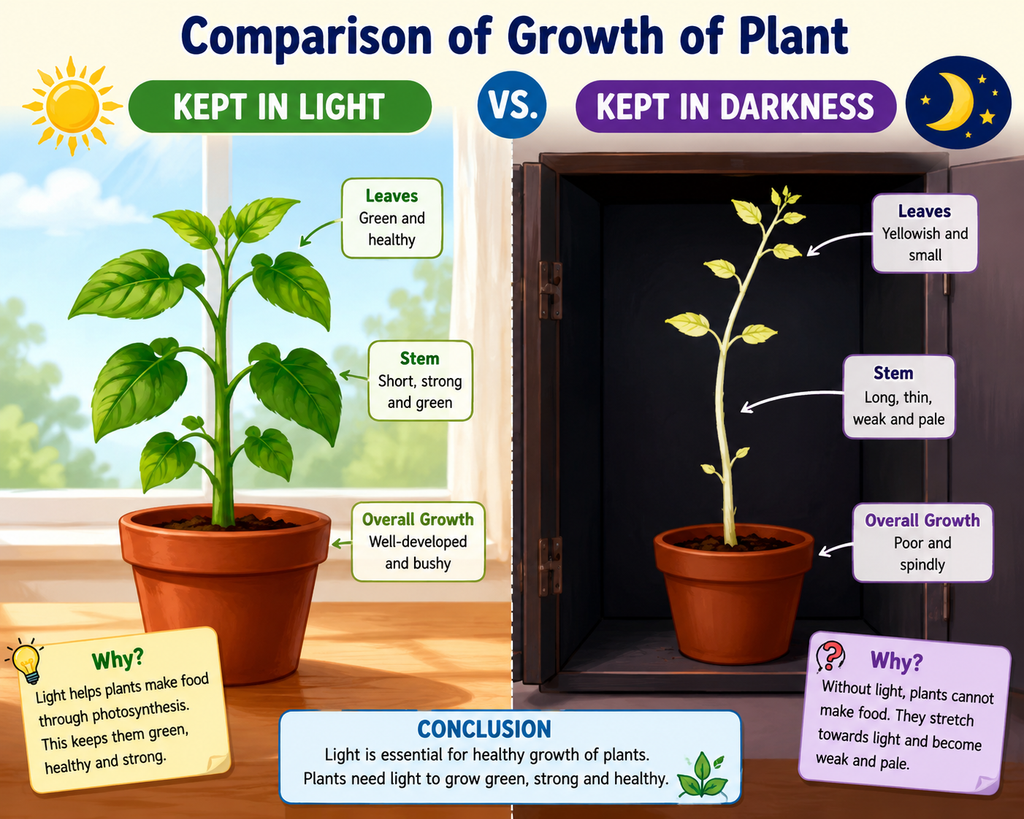
Scientific questions often begin with How, Why, What if, or What happens when…?
In short, a scientist looks at the same world as everyone else, but notices what others miss and asks, “How do we know this is true?”
Observation vs Inference: Seeing vs. Figuring Out
Observation and inference are closely connected, but they are not the same. Understanding the difference between them is an important part of scientific thinking.
An observation is information that you directly notice or measure using your senses or scientific tools. An inference is an explanation or conclusion you draw from your observation.
Let’s take a simple everyday example: The Wet Footprints
Imagine walking into your home after school and noticing wet footprints on the living room floor.
- Observation: “I see five wet, shoe-shaped marks leading from the main door to the kitchen.” (This is direct visual data.)
- Inference: “Someone may have walked in from outside wearing wet shoes.” (This is an explanation you created by connecting the footprints to past experience.)
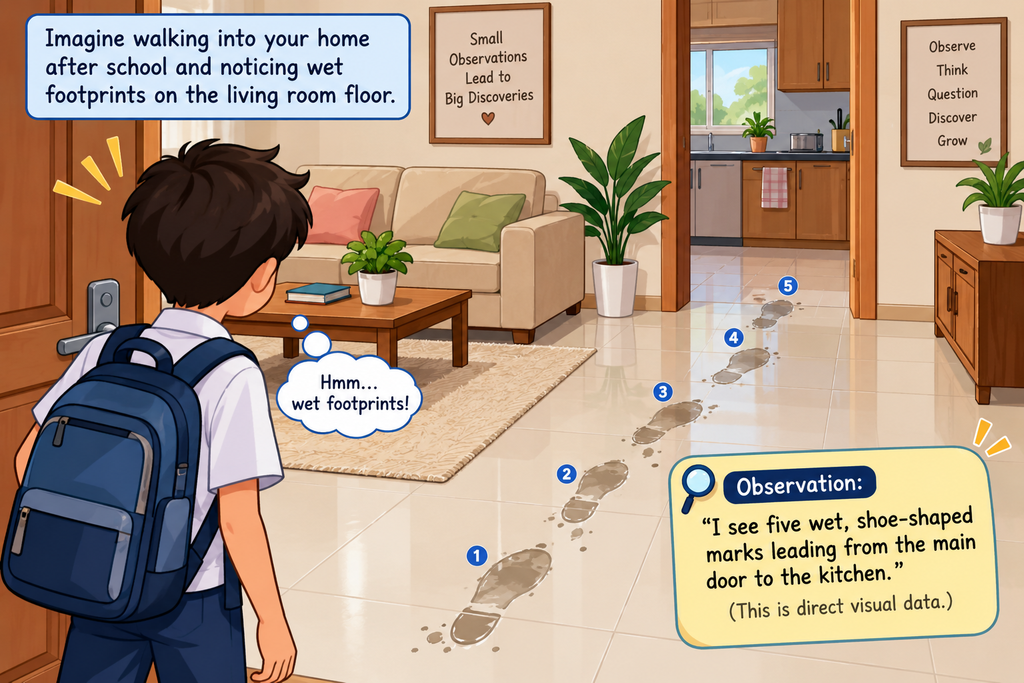
Notice the difference? The footprints are real observations. But your inference could be wrong—maybe someone spilled a bucket of water and stepped in it! That is why scientists carefully separate what they observe from what they think the observation means. Why does this matter? Because if we treat our inferences as facts, we may stop asking questions and investigating further.
What Is a Hypothesis? Is It Just a Guess?
We all make guesses. “I guess it will rain today because it is cloudy.”
But a hypothesis is different from a random guess.
Suppose you notice that a plant kept near a window is leaning towards the window. You wonder: “Why is the plant bending towards the window?”
You might suggest: “Perhaps the plant grows towards the light.” That is a hypothesis—a possible explanation that can be tested through investigation.
A hypothesis is a testable idea or possible explanation based on observations, existing knowledge or reasoning.
Let’s see how it can be investigated.
You could investigate whether light affects the direction of plant growth.
For example, you might predict: “If a plant receives light mainly from one side, its shoot will tend to grow towards that light.”
Now you have something that can be investigated. If your results support the hypothesis, your idea gains evidence. If the results do not support the hypothesis, that is perfectly fine. The purpose of an experiment is not to prove ourselves right, but to find out what the evidence tells us.
The Steps of a Scientific Investigation:The Detective Cycle of Science
Scientific investigation often follows a series of steps. It is called a cycle because the process does not always end with a conclusion. The results may lead to new questions, new hypotheses and further investigations. In this way, scientific investigation can continue again and again.
Here is how it works:
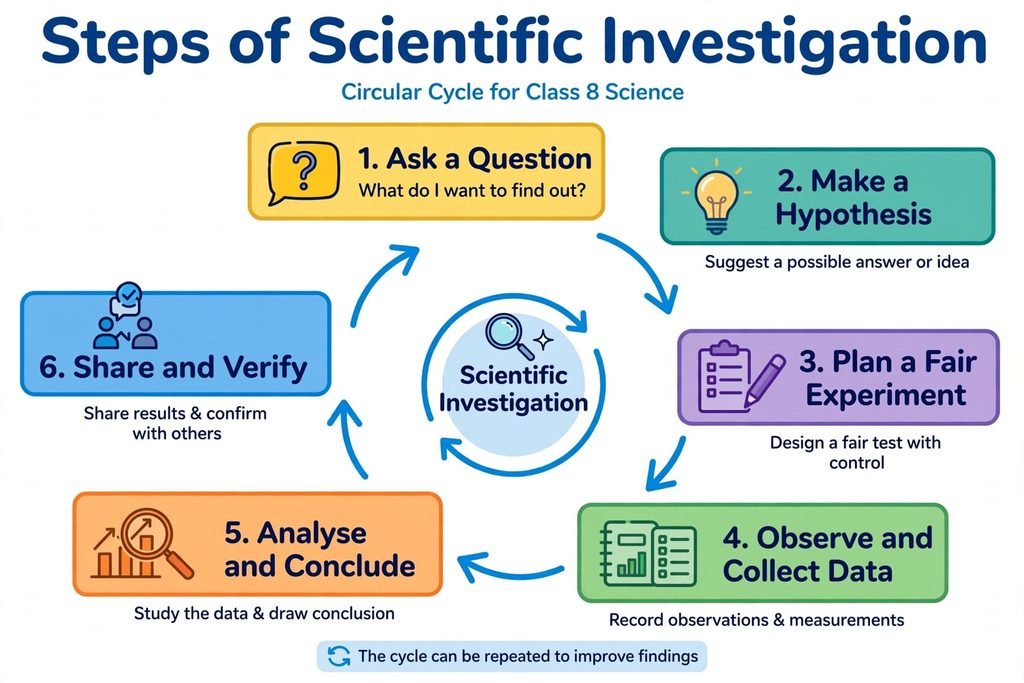
The diagram above shows how the different steps of a scientific investigation are connected.
Example of a Scientific Investigation
Let’s see how this works in real life. Suppose you want to know:
“Does the temperature of water affect how quickly sugar dissolves?”
You may form a hypothesis: “Sugar will dissolve faster in warm water than in cold water.”
To test this, take equal amounts of warm and cold water in two glasses. Add the same amount of sugar to each glass and stir them in the same way. Observe and record how long the sugar takes to dissolve in each glass.
Compare your observations. If the sugar dissolves faster in warm water, your results support the hypothesis. If the results are different from what you expected, you can reconsider your hypothesis or repeat the investigation.
However, one small experiment does not automatically establish a scientific rule. Scientists often repeat investigations and carefully control the conditions to make their results more reliable.
Fair Tests and Why They Matter: The Rule of One Change
Imagine you want to investigate: “Does water affect seed germination?”
You take two pots.
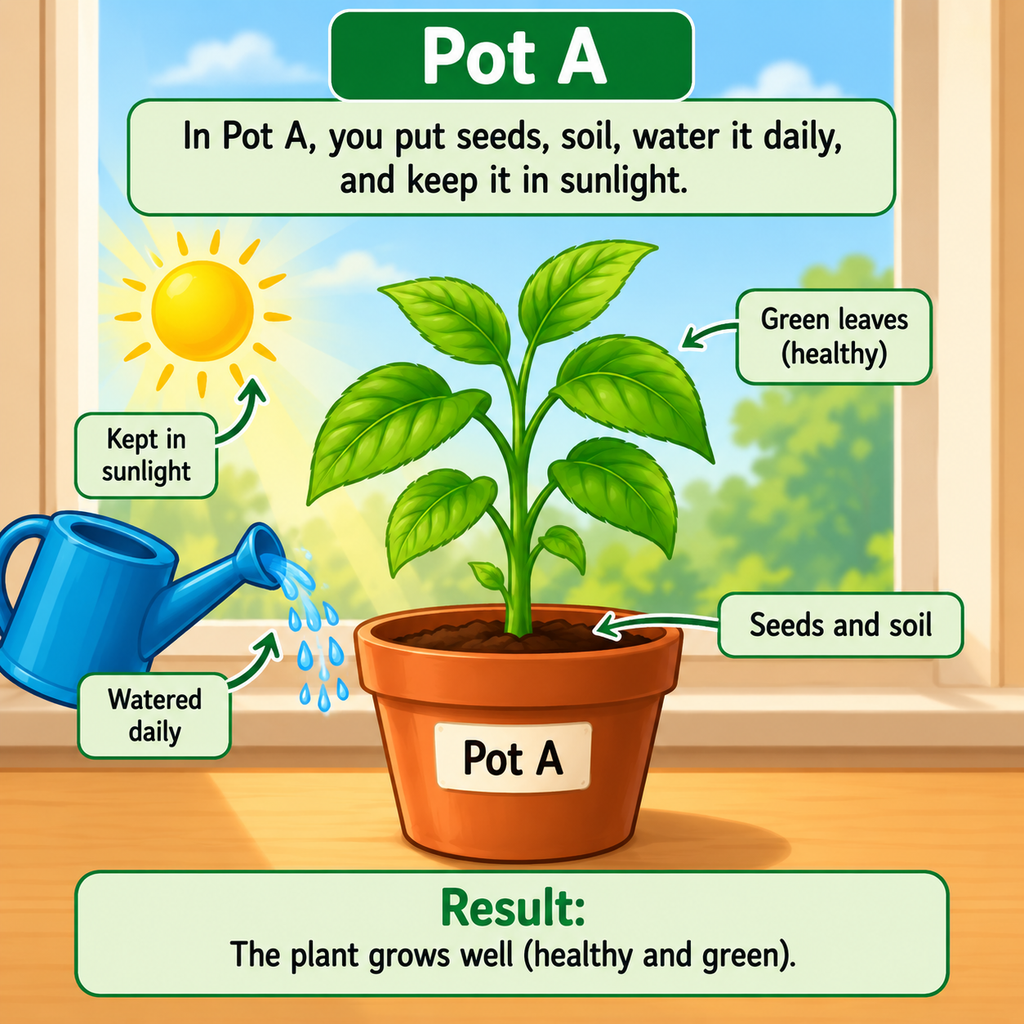
In Pot A, you put seeds, soil, water it daily, and keep it in sunlight.
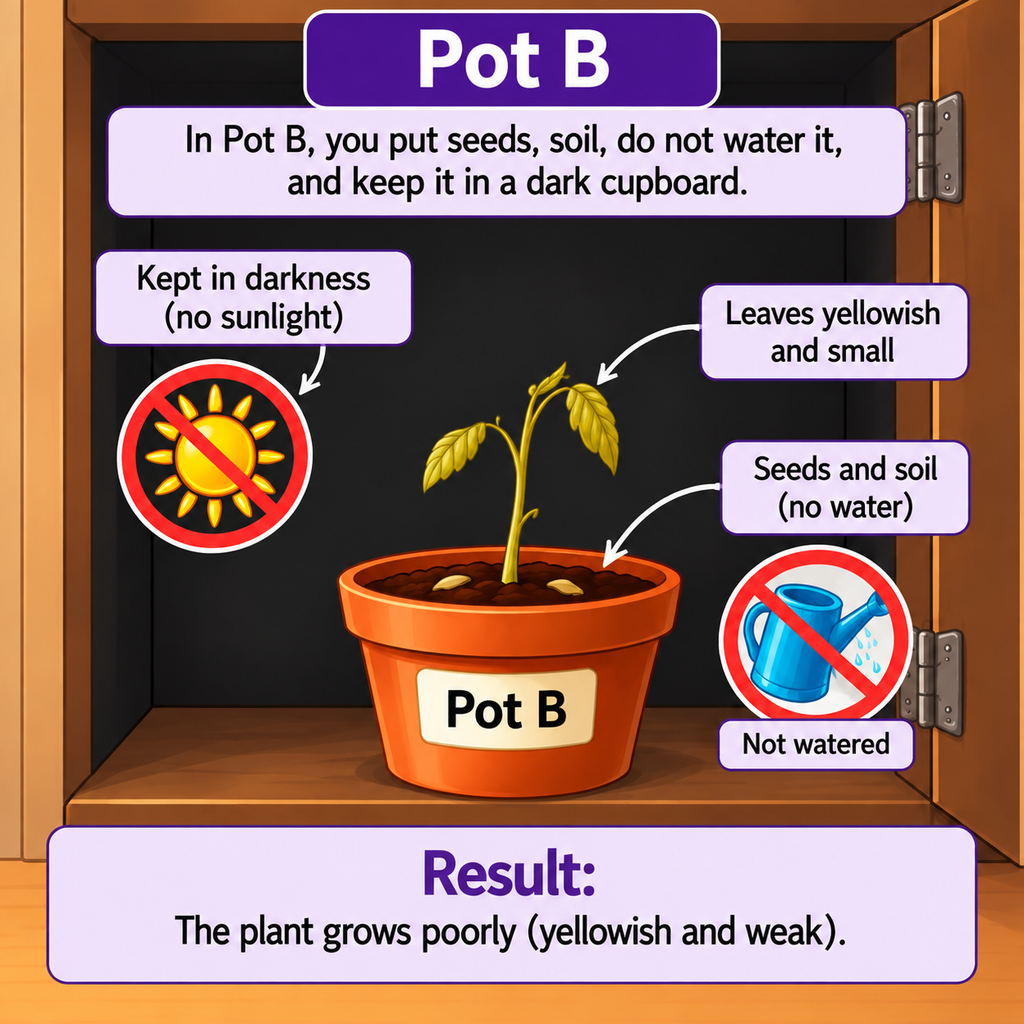
In Pot B, you put seeds, soil, don’t water it, and keep it in a dark cupboard.
After 5 days, Pot A sprouts. Can you say water was the reason? No! Because you changed TWO things – water AND light. Maybe it was the light that made the difference.
This is why experiments need to be fair tests. For a test to be fair, you must control your variables.
In a scientific investigation, we commonly work with three types of variables:
- Independent Variable: What you change on purpose (e.g., amount of water).
- Dependent Variable: What you measure or observe (e.g., how fast seeds germinate).
- Controlled Variables: What you keep exactly the same (e.g., type of seed, amount of soil, same amount of sunlight, same pot size).
💡 Activity: Try It Yourself
Question: Does the amount of salt affect how quickly ice melts?
1. Take three identical bowls with exactly 100g of ice cubes in each (controlled).
2. Bowl 1: No salt (independent variable = 0 spoon).
3. Bowl 2: 1 spoon salt.
4. Bowl 3: 2 spoons salt.
5. Keep all bowls in the same room at the same temperature (controlled).
6. Measure the time taken for ice to melt completely in each (dependent variable).
Now this is a fair test, because you changed only ONE thing – the amount of salt. So if Bowl 3 melts fastest, you know for sure it was because of salt.]
Why do scientists repeat experiments?
In everyday speech, people often say, “I believe this because it feels right.” But in science, personal beliefs aren’t enough. Scientists rely on Evidence and Data. Evidence may come from observations, measurements, experiments, photographs, samples, records or other reliable sources of information.
Why Is Repetition Important?
1. To check for mistakes: Repeating an experiment can help identify errors in measurement or procedure.
2. To check that the result is not due to chance: A result obtained only once may happen by chance. Repeating the experiment helps us see whether the same result occurs again.
3. To make the results more reliable: When an experiment gives similar results after being repeated under the same conditions, we can have greater confidence in the findings. This process helps in verification. In scientific research, experiments and findings may be checked or repeated by other scientists to see whether similar results can be obtained. This makes scientific findings more reliable.
Fact, Opinion or Myth: Can We Tell the Difference?
Not everything we hear is a scientific fact.
Scientific fact
A scientific fact is a statement strongly supported by reliable evidence and repeated observations or measurements.
For example:
Water freezes at 0°C under standard atmospheric pressure.
Opinion
An opinion expresses someone’s personal belief or preference.
|“Mangoes are the best fruit.”That may be your opinion—and a perfectly reasonable one! But it is not a scientific fact.|
Myth
A myth is a commonly repeated belief that may not be supported by scientific evidence.
Consider this familiar claim:
“Antibiotics can cure a common cold.”
This is false. Common colds are caused by viruses, while antibiotics act against bacteria, not viruses. Using antibiotics when they are not needed can also contribute to antibiotic resistance.
Another common myth is:
“A watermelon seed will grow into a watermelon plant inside your stomach if you swallow it.”
This does not happen. A swallowed seed normally passes through the digestive system and cannot grow into a watermelon plant inside your stomach. The lesson is not to believe or reject something merely because it sounds convincing. Ask:
“What is the evidence?”
A seed needs suitable conditions such as water, air and the right temperature to germinate. Inside our stomach, these conditions are not suitable for a seed to grow into a plant. The stomach contains digestive juices and acids that help break down food, and the swallowed seed usually moves through the digestive system. Therefore, a watermelon seed cannot grow into a watermelon plant inside our stomach.
Let’s bust two common myths with science:
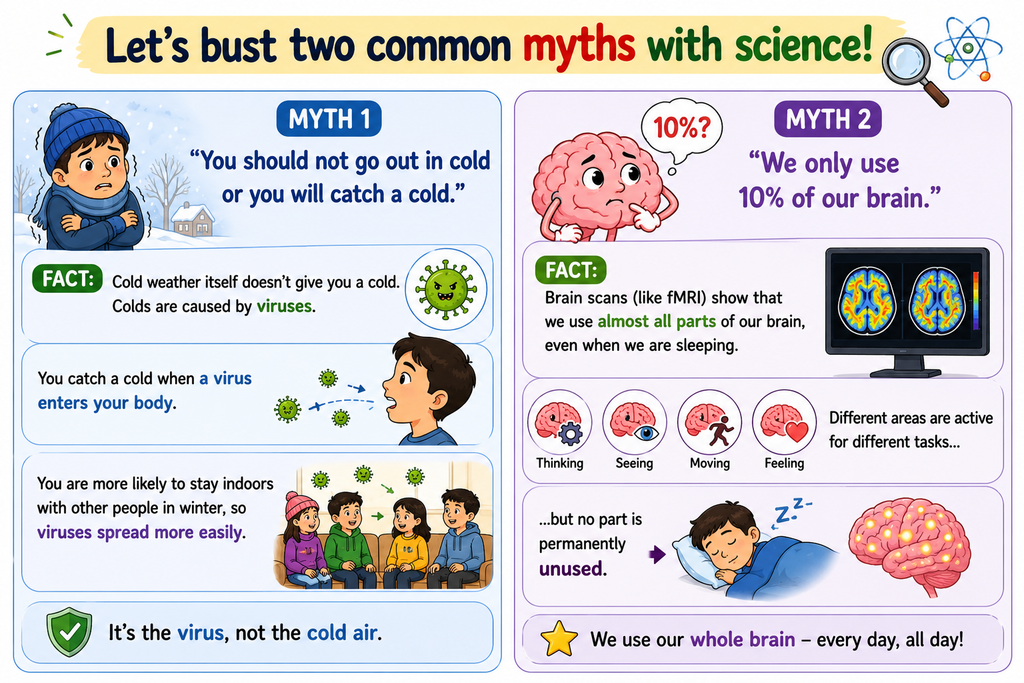
Tools Scientists Use: Extending Our Senses
Our senses help us observe the world around us, but they have limits. We cannot see tiny micro-organisms with our naked eyes or measure temperature accurately just by touching something. Scientists therefore use different tools to observe and measure things more accurately.
Here are some common tools:
- Thermometer — measures temperature.
- Magnifying lens — makes small objects appear larger so details can be observed more easily.
- Measuring cylinder — measures the volume of liquids.
- Ruler or metre scale — measures length or distance.
- Balance — measures mass.
- Stopwatch — measures time intervals.
- Microscope — magnifies very small objects, such as many microorganisms and cells, so they can be studied.
- Measuring tape — useful for measuring larger lengths or distances.
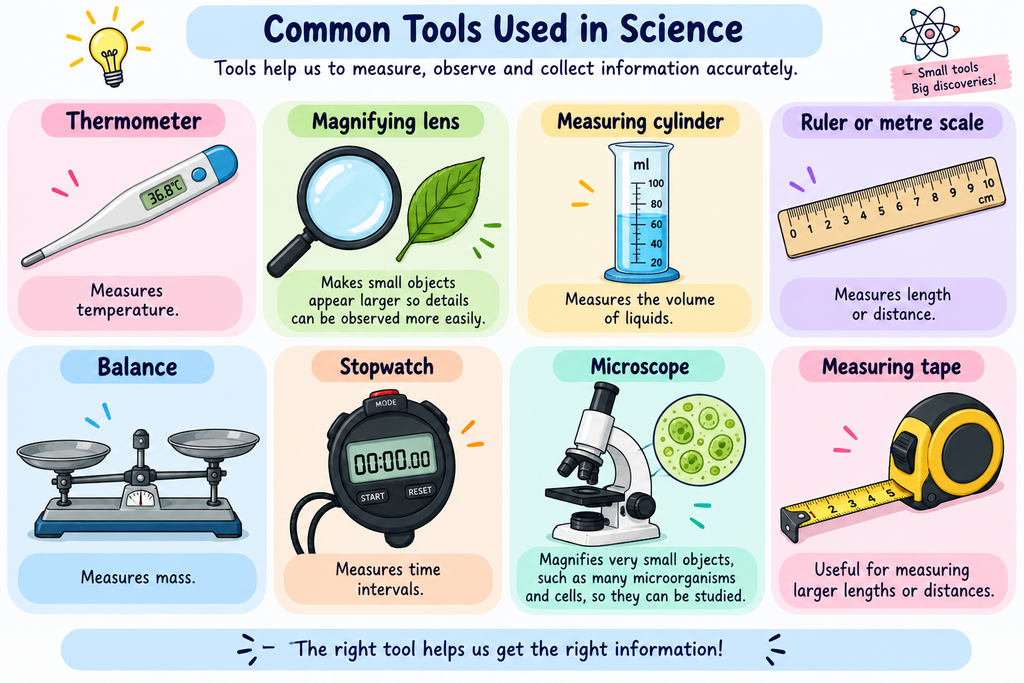
The important point is that a tool is useful only when we know what we are trying to observe or measure. For example, if you want to know whether water is getting warmer, simply saying “It feels warm” is less accurate than measuring its temperature with a thermometer.
Why This Matters in Real Life: Science is a Life Skill
You might be thinking, “This is interesting, but when will I actually use it?” The answer is: much more often than you think.
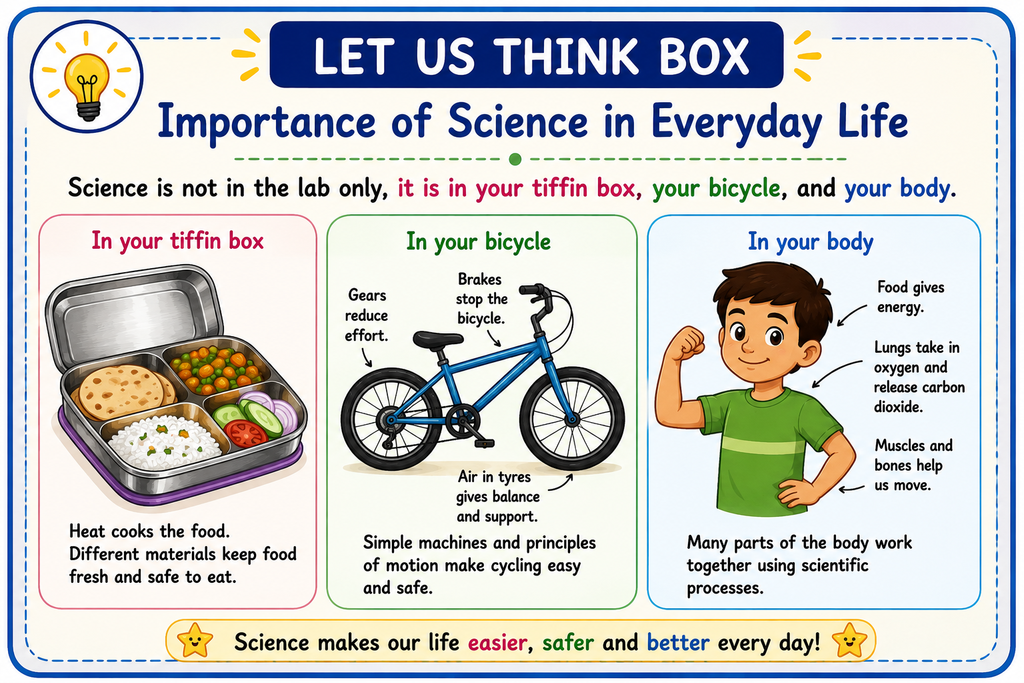
Science and technology
Everyday technologies are built using scientific knowledge and tested through investigation.
When engineers develop a new battery, mobile phone, bridge or water-purification system, they do not simply create a design and assume that it will work. They test materials, measure performance, identify problems and improve the design. That is scientific thinking in action.
Science and health
Health decisions also depend on evidence.
Scientists investigate diseases, medicines, vaccines, nutrition and ways of preventing infections. Before many medical treatments are widely used, they undergo careful research and testing.
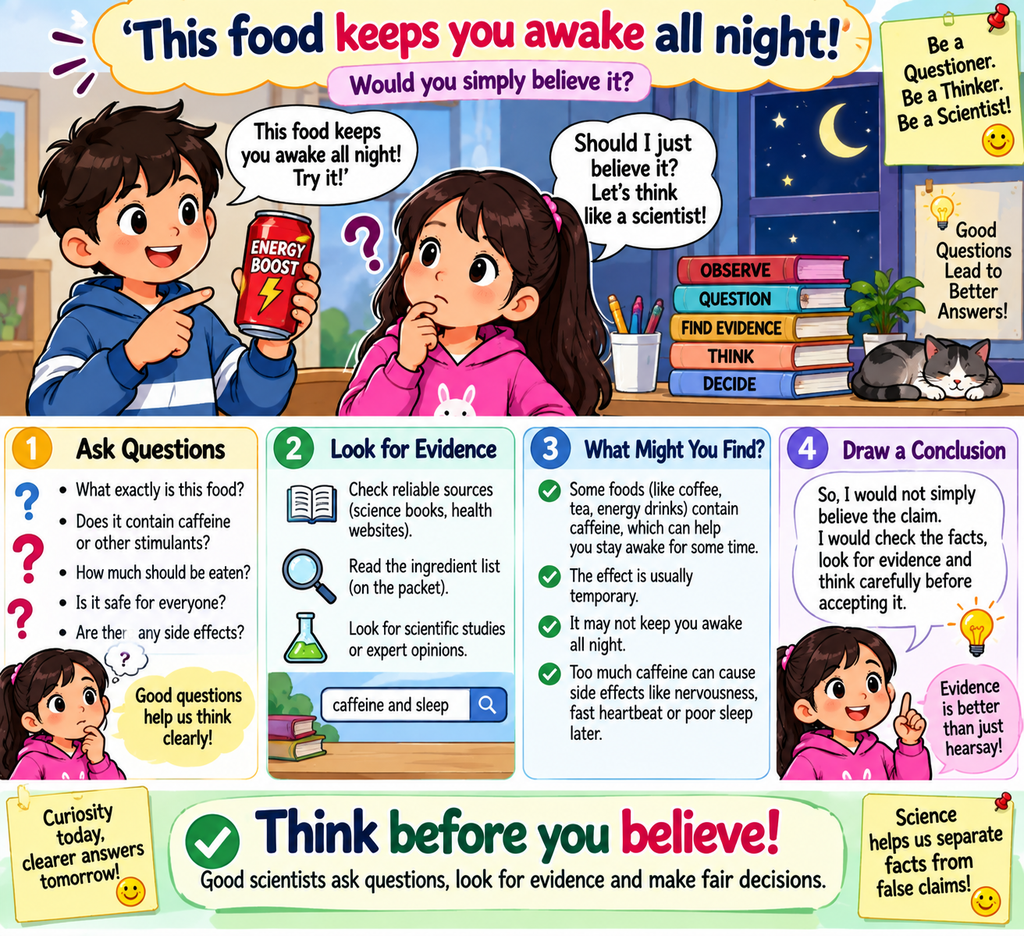
Even as a student, scientific thinking can help you make sensible decisions. Instead of believing every health message you receive online, ask:
Who made this claim? What evidence supports it? Is the source trustworthy?
Science and the environment
Think about air pollution, water quality, climate change, waste management or biodiversity.
We cannot understand such problems simply by looking at one day or one location.
Scientists collect observations and measurements over time, compare data and build evidence-based explanations. Scientists collect observations and measurements over time, compare data and build evidence-based explanations. Scientific thinking can therefore help us make better decisions about the world we share. Scientific thinking can therefore help us make better decisions about the world we share.
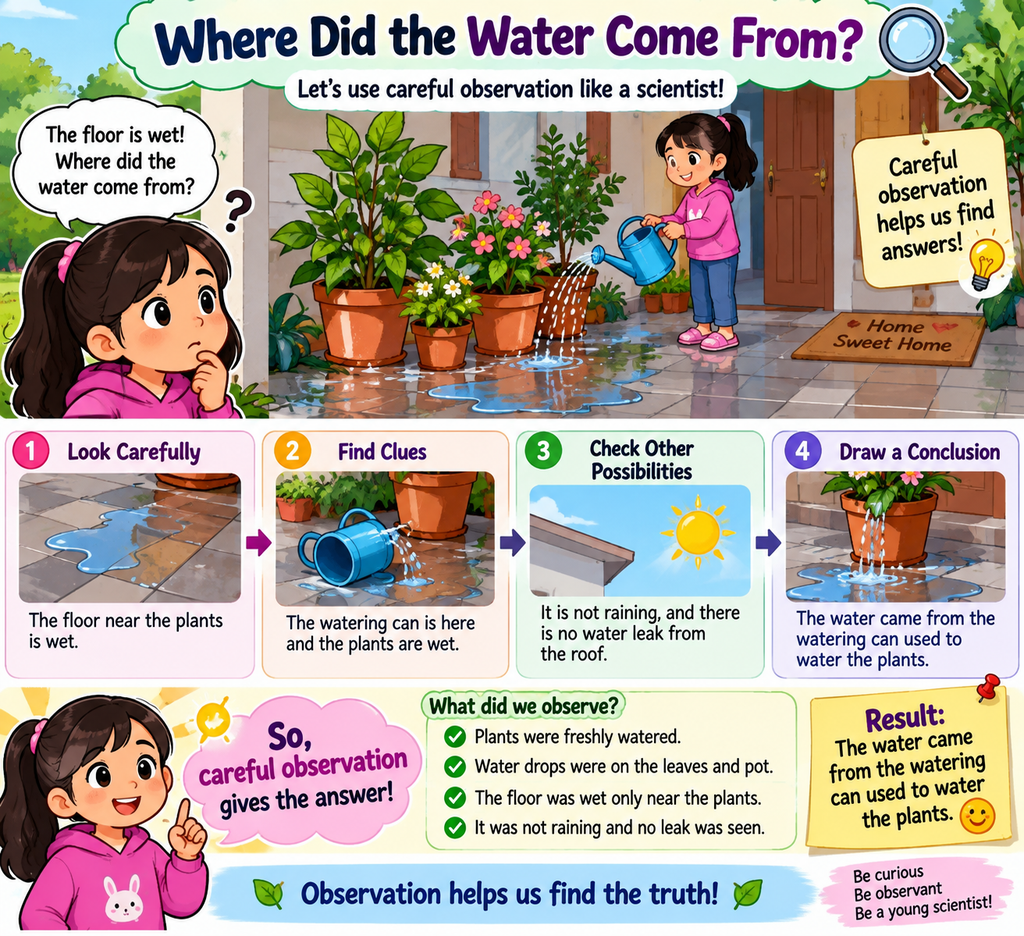
Let’s Think! 💡
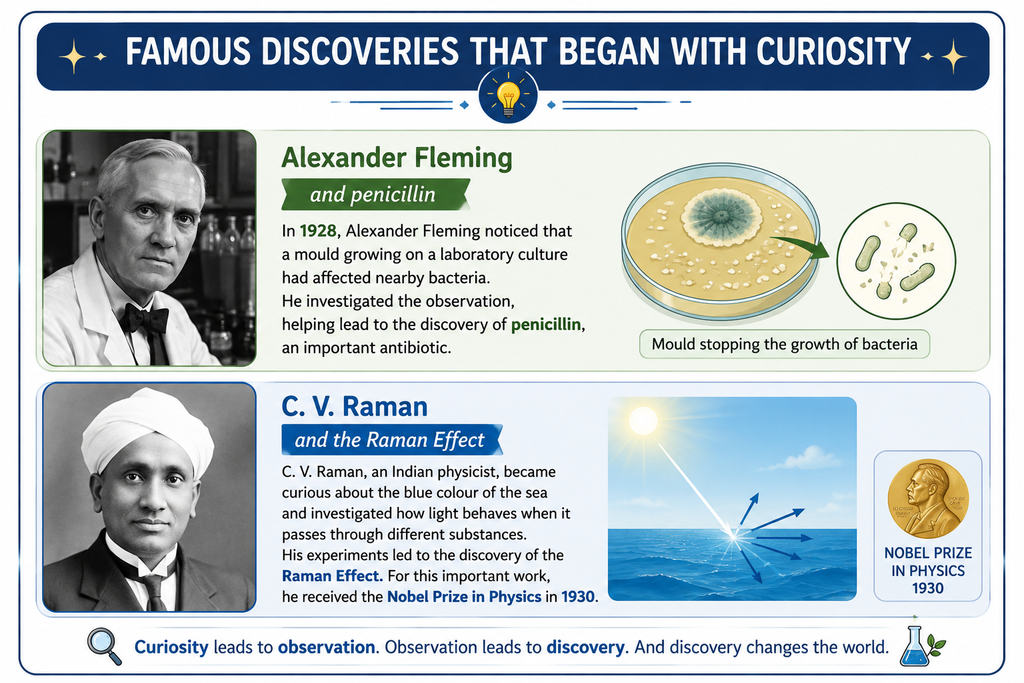
Famous Discoveries That Began with Curiosity
Science Is a Journey, Not a List of Final Answers
One of the most exciting things about science is that it keeps developing.
A scientific investigation may answer one question and create several new ones.
For example:
Why does an iron object left outdoors slowly develop rust?
You investigate and learn that certain conditions help rusting occur.
This may lead to another question:
“Does iron rust at the same rate under all conditions?”
And that question can lead to another investigation. This is why science is sometimes compared to an adventure. There is always something else to discover.
Conclusion: Be Curious, Be Careful, Be Ready to Investigate
You don’t have to wait to grow up to think like a scientist. The next time you notice your shadow is longer in the evening than at noon, or wonder why droplets appear on the outside of a cold glass, you are already taking the first step towards scientific investigation. Start small. Keep a small curiosity diary. Write one observation and one question every day. Whenever possible, try simple and safe investigations to explore your questions. Ask “how do we know this?” before you believe something.
The investigative world of science is not far away in a lab. It starts right here, in your kitchen, your balcony, and in that wonderful “why” inside your head.
Keep questioning. Keep investigating.
Frequently Asked Questions
1. What is the difference between an observation and an inference?
An observation is what you directly notice or measure. An inference is an explanation you draw from that observation. For example, seeing water on a floor is an observation; concluding that a pipe may be leaking is an inference.
2. Is a hypothesis the same as a guess?
No. A hypothesis is a testable possible explanation based on observations, knowledge or reasoning. A random guess does not necessarily provide a way to test it.
3. Why should we change only one variable in a fair test?
Changing one important variable while keeping other relevant conditions the same makes it easier to determine what caused the observed difference. If several things change at once, it becomes difficult to identify the cause.
4. Why do scientists repeat experiments?
Scientists repeat experiments to check whether the results are consistent and reliable. Repetition also helps identify possible errors and reduces the chance that a result occurred simply by chance.