Entering Class 9 is more than moving into a new school year. It is also a step into a deeper way of understanding science. In earlier classes, you may have learned to observe things around you, ask questions, perform simple activities and discover how the world works. Now, science asks you to go a little further.
This chapter introduces you to the ways of thinking, exploring and understanding science that will become increasingly important at the secondary stage.
Introduction: Why is Secondary Science Different?
Till Class 8, you explored science through observation, investigation, experiments and everyday experiences—from understanding the living world and materials around us to exploring forces, light, matter and our environment.
At the secondary stage, the questions become deeper. You will not just ask what happens, but also why it happens, how it happens and how we can be sure. Secondary science takes you from just observing the world to explaining it with evidence and logic.
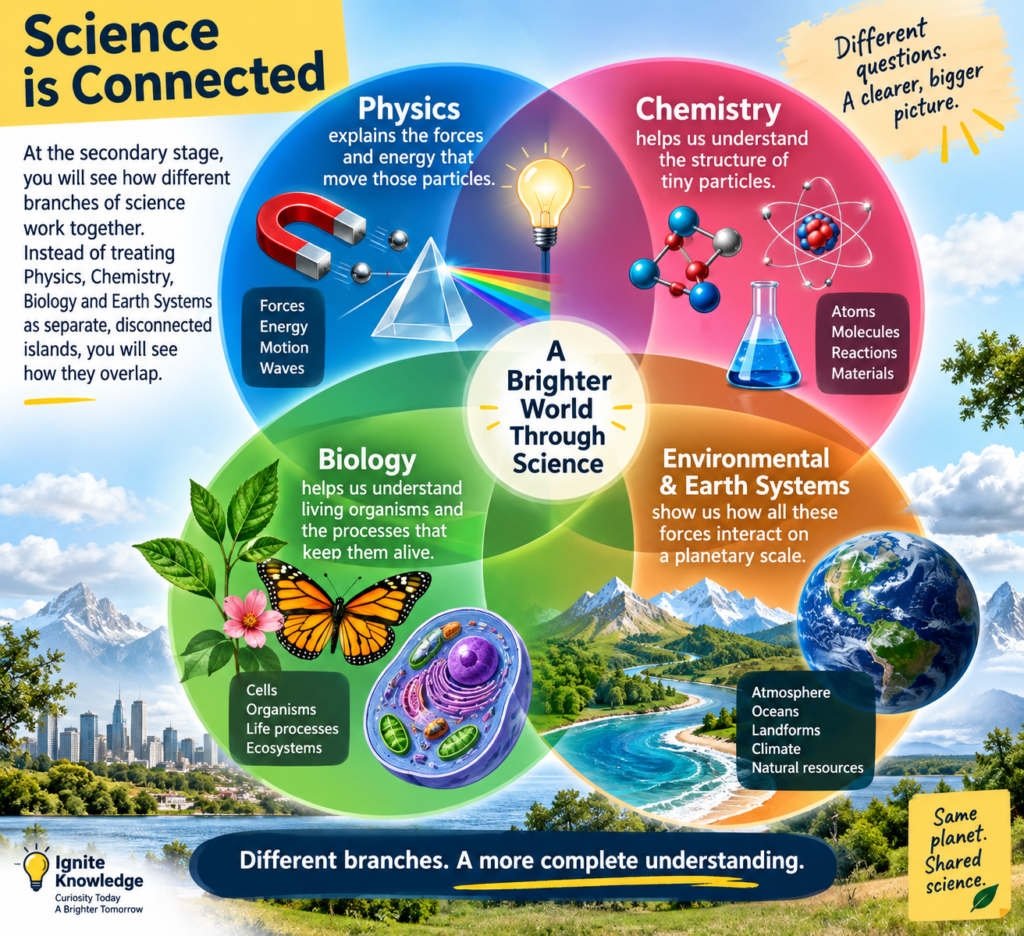
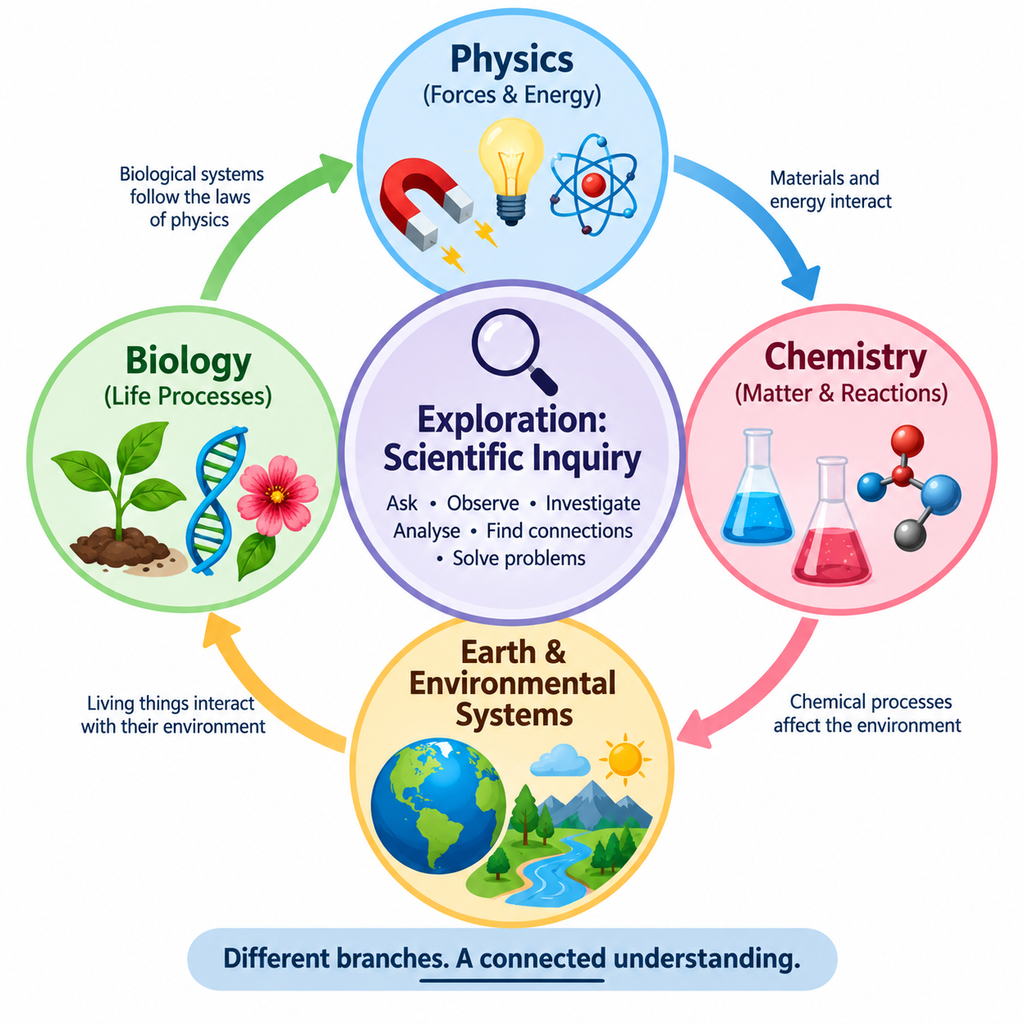
Secondary science connects different branches of study. Instead of treating Physics, Chemistry, Biology, and Earth Systems as separate, disconnected islands, you will see how they overlap:
Chemistry helps us understand the structure of tiny particles.
Physics explains the forces and energy that move those particles.
Biology helps us understand living organisms and the processes that keep them alive.
Environmental & Earth Systems show us how all these forces interact on a planetary scale.
Why Does Science Use Models?
The natural world is extremely complex. Imagine trying to describe every movement of every molecule in a glass of water or every cell in the human body. It would be almost impossible.
To make such complicated situations easier to understand, science uses models.
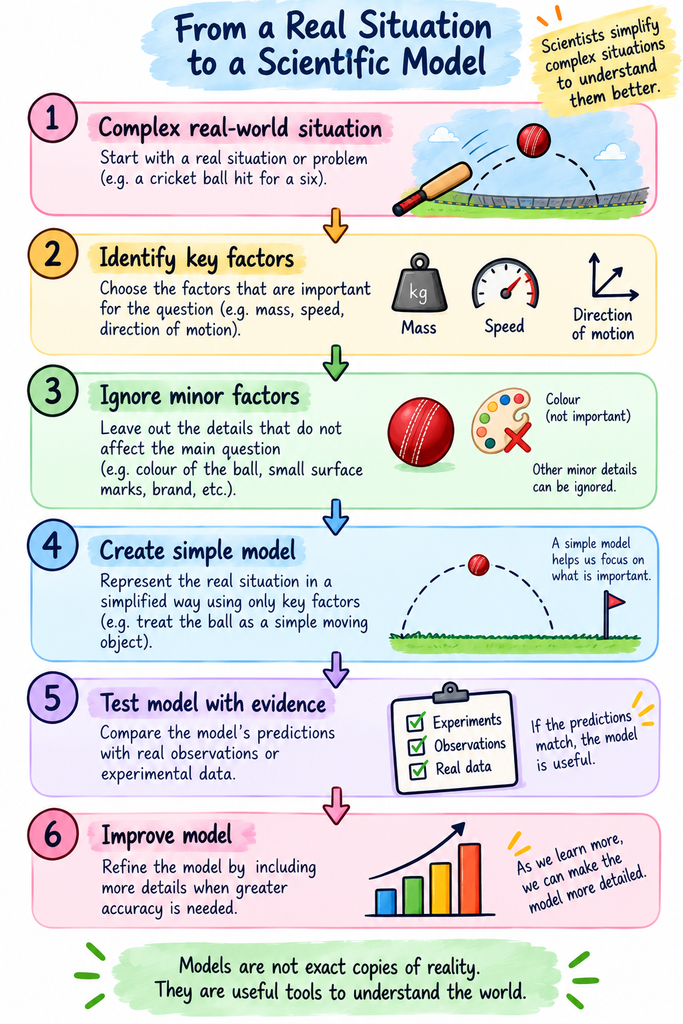
A model is a simple representation that keeps the important details and ignores the less important ones.
For example, when studying the motion of a car, we may represent the car as a single point. We do not need to draw every screw, tyre tread or seat if our question is simply about how the car moves.
Similarly:
- Atoms and molecules may be represented using spheres and bonds.
- Cells may be represented using diagrams showing their important structures.
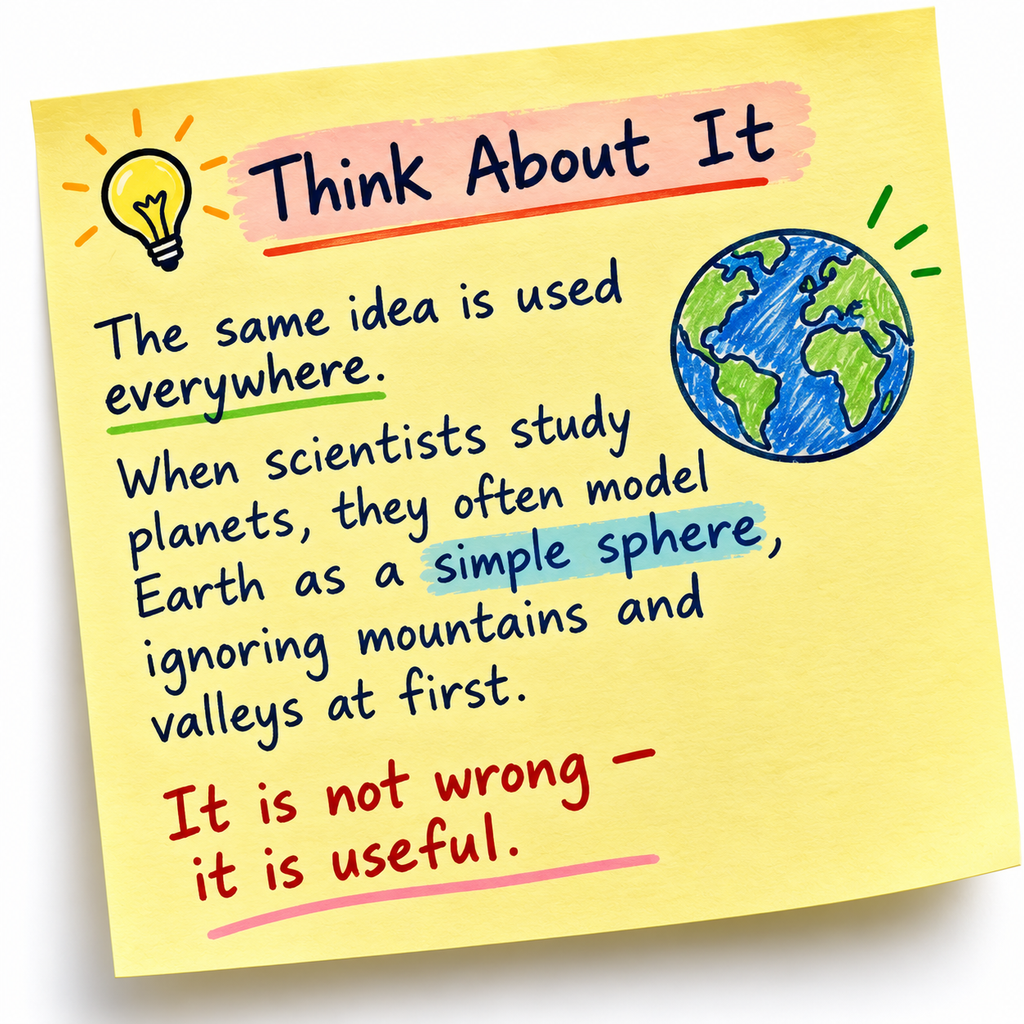
- Earth may be represented as a layered sphere.
- A falling object may be studied while ignoring air resistance in a simple model.
These simplifications are not mistakes. They are deliberate choices.
A model is useful because it allows us to concentrate on the features that matter.
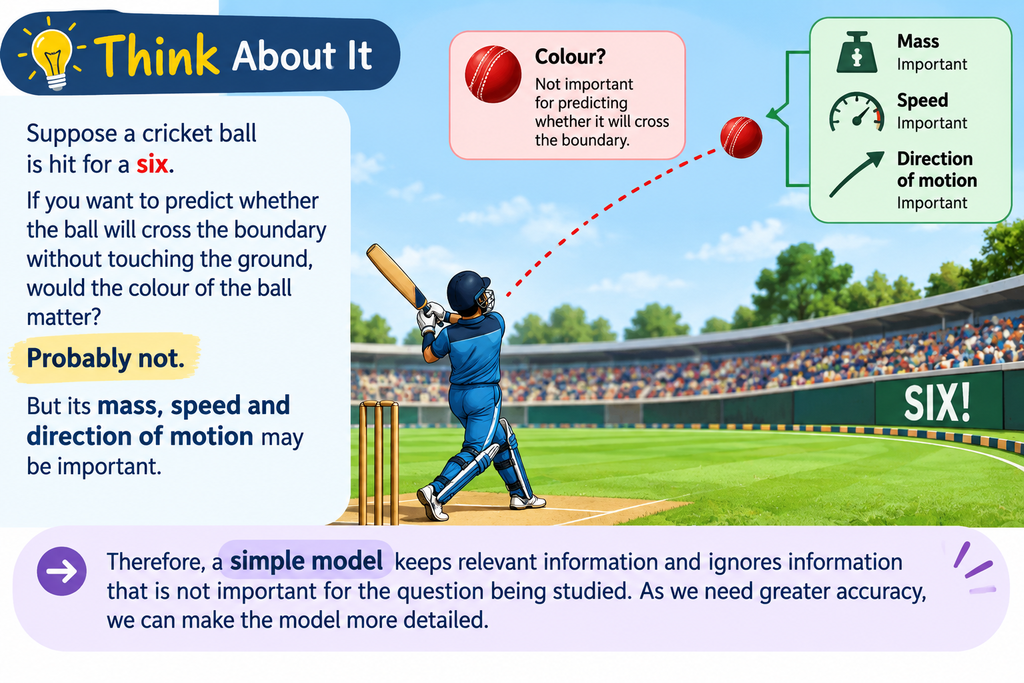
So, a model is not a copy of reality. It is a tool to make reality understandable.
Let us understand through a simple flowchart
A Scientist Who Used Simplification
The chapter introduces the work of Indian scientist Meghnad Saha as an example of scientific modelling.
Stars are enormously complicated systems. They contain huge numbers of particles and involve many physical processes. Instead of trying to describe everything happening in a star at once, Saha focused on the factors that were most important for his study.
He considered stellar matter as a hot gas and focused on important factors such as temperature, pressure and the formation of ions. This kind of simplification helped in understanding the connection between the colour of stars and their temperature.This example teaches us an important lesson.
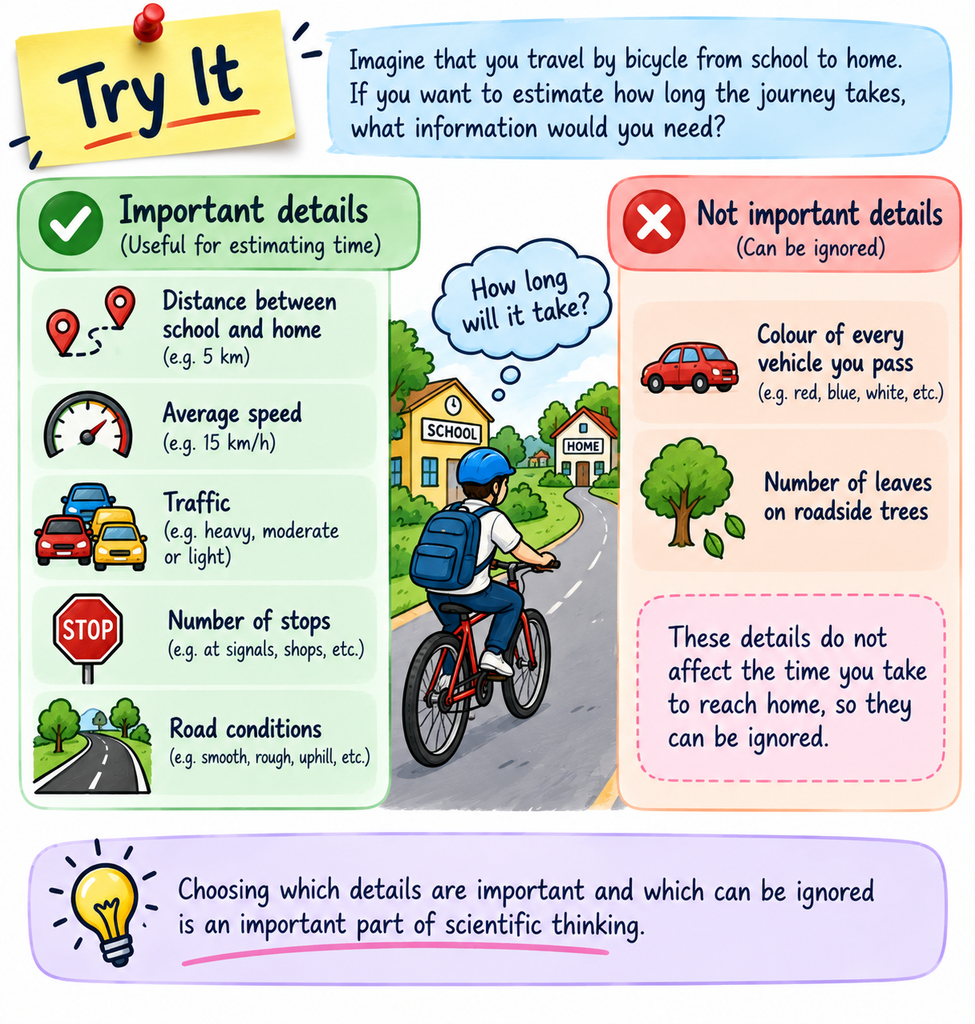
Good scientific models do not have to include everything. They need to include what matters for the question being investigated.

Try it Yourself
Science Has Its Own Precise Language
Science uses many words that we also use in everyday life, but their meanings can be more precise in scientific contexts.
Consider the word work. In everyday language, you might say, “I worked for three hours.” In science, however, work has a specific meaning related to force and displacement.
Similarly, words such as force, cell, reaction, energy and many others have particular scientific meanings. This precise language is important because it helps scientists communicate their ideas clearly and avoid confusion. Science also uses symbols and units. For example:
- mass can be represented by m;
- velocity by v;
- force by F;
- electric current by I.
These quantities are measured using defined units.
Standard units make scientific communication much easier. If scientists in different countries used completely different units for the same quantity, comparing their results would become difficult.
Why Are Standard Units Important?
Imagine buying one kilogram of rice from a shop. You expect a kilogram to represent the same amount regardless of where you buy it. Standard units provide consistency.
They help scientists:
- compare measurements;
- communicate results;
- reproduce experiments;
- avoid confusion;
- reduce errors in practical situations.
Mistakes involving different units can have serious consequences, which highlights the importance of using standard units carefully.
Mathematics: A Language of Science
Many students feel nervous when mathematics appears in science. But mathematics is not simply a collection of calculations that scientists use to make life difficult! It is a language for expressing relationships.
Suppose we want to describe motion. We may use quantities such as distance, time and velocity. Mathematical relationships allow us to understand how these quantities are connected.
Similarly, mathematics can help scientists describe:
- chemical reaction rates;
- population growth;
- changes in energy;
- movement of objects;
- patterns in data.
An equation is therefore more than something to memorise. It is a concise way of showing how different scientific quantities are related.
A useful habit is to understand the situation first, identify the quantities involved, and then decide which mathematical relationship is appropriate.
Remember: understanding comes before calculation
Prediction: Using Science to Look Ahead
One powerful feature of science is its ability to make predictions.
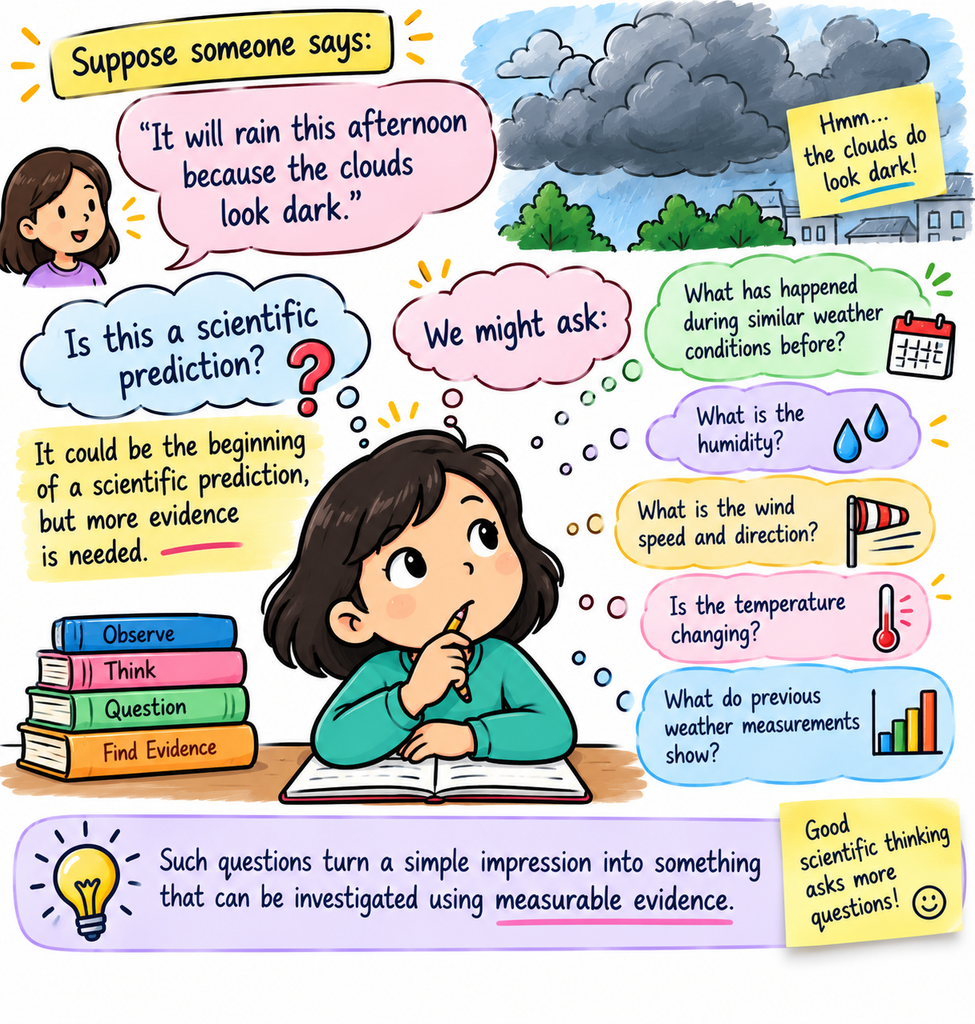
A scientific prediction is not simply a guess. It is a reasoned expectation based on evidence, established knowledge, models or patterns.
For example,
• knowledge of motion can help us predict how a football might move after being kicked.
• Knowledge of biology can help us understand how breathing changes during exercise.
• Knowledge of chemistry can help us predict outcomes of certain chemical processes. However, scientific predictions need to be tested against observations or evidence
When Predictions Go Wrong
What happens when a scientific prediction does not match observation? Scientists do not simply ignore the result. They ask:
Why did the prediction not match the observation?
Perhaps:
- the model was too simple;
- an assumption was incorrect;
- a measurement was inaccurate;
- an important factor was ignored;
- the conditions were different from those expected.
This is not a failure of science. In fact, it is one of the ways science improves.
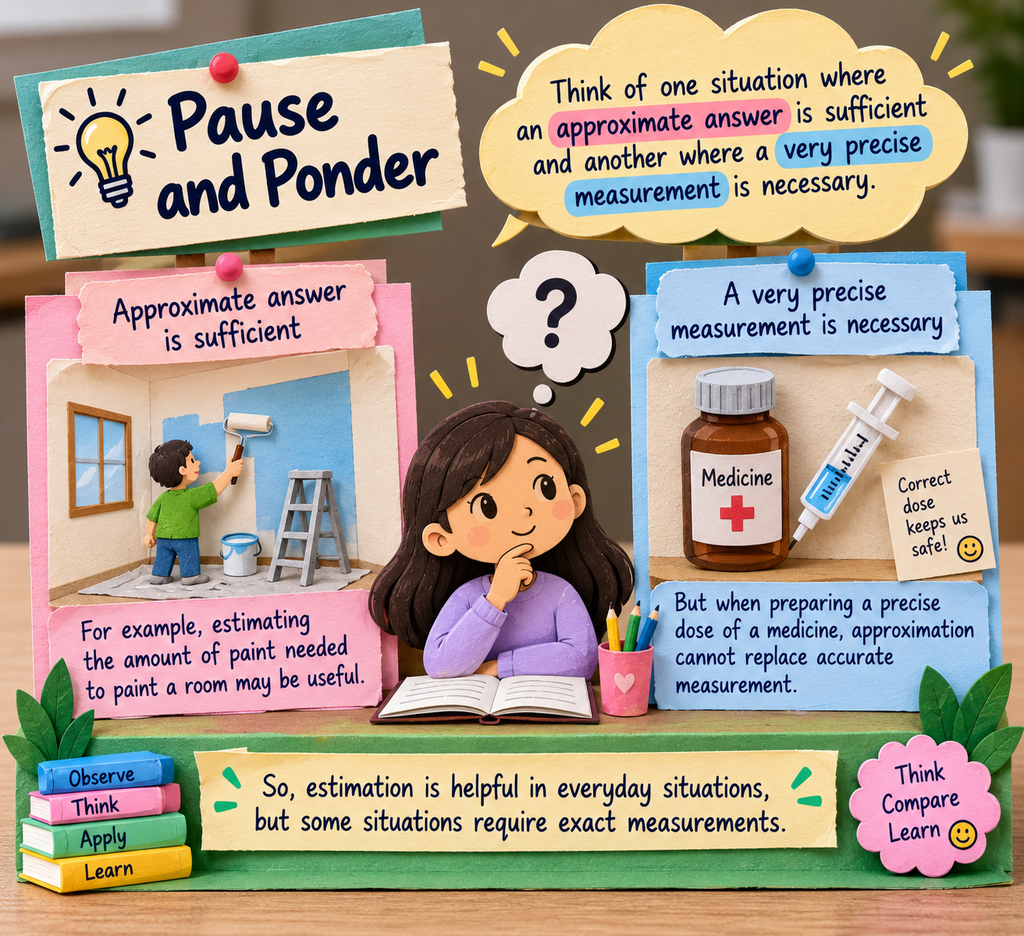
Estimation: Is Your Answer Reasonable?
Science does not always require an exact answer immediately. Sometimes an estimate is enough to decide whether an answer is reasonable.

Why Is Estimation Useful?
Estimation can help you:
- check calculations;
- detect unreasonable answers;
- develop scientific intuition;
- make quick decisions;
- understand quantities in everyday situations.
Key Takeaways / Chapter Summary
- Science is not only about knowing facts; it is also about understanding how we know them.
- Scientific exploration begins with curiosity, careful observation and meaningful questions.
- Models are simplified representations of complex systems.
- A model deliberately includes important details and may ignore less important ones.
- Science uses precise terminology, symbols and standard units for clear communication.
- Mathematics acts as an important language for expressing relationships between quantities.
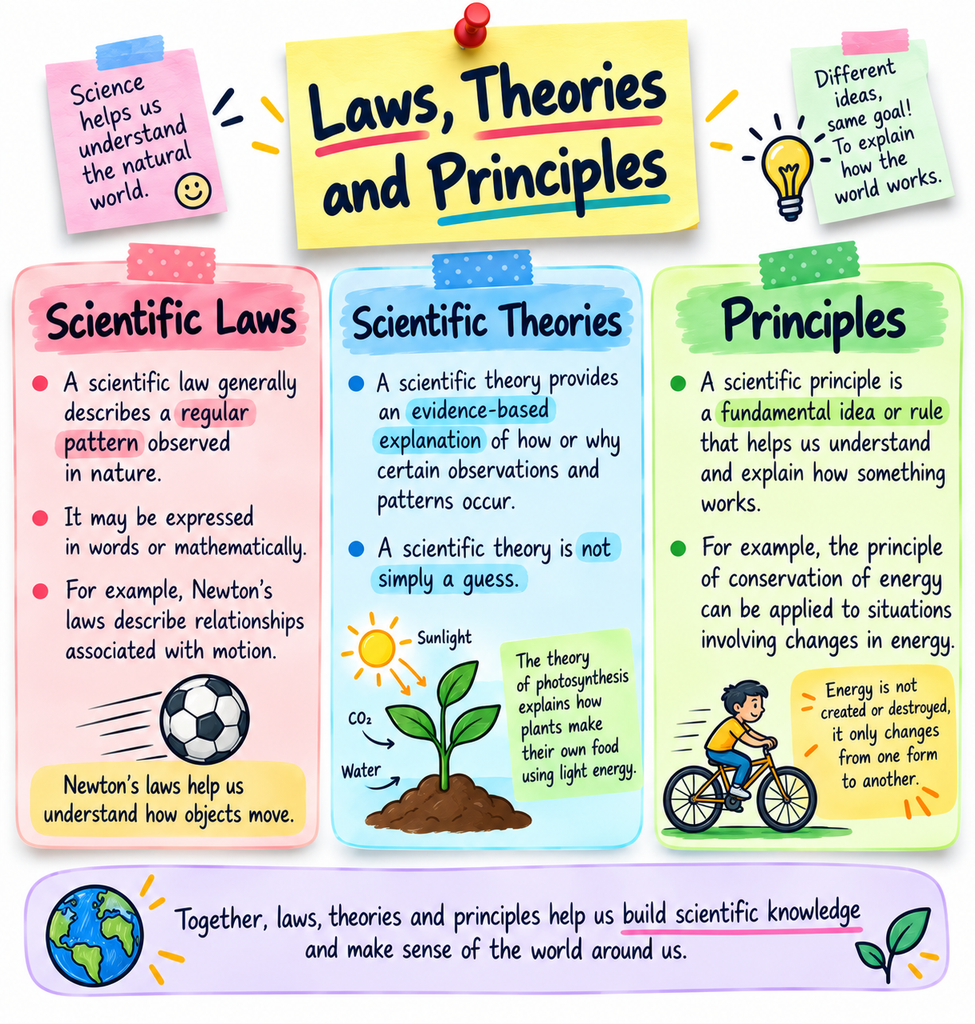
- A scientific law generally describes a pattern observed in nature, while a scientific theory provides an evidence-based explanation.
- Scientific predictions are based on evidence and reasoning rather than mere guesswork.
- When observations disagree with predictions, scientists examine their assumptions, models and measurements.
- Estimation helps us judge whether an answer is reasonable.
- Different branches of science are interconnected and often work together to solve real-world problems.
- Scientific thinking encourages us to question claims and look for evidence.
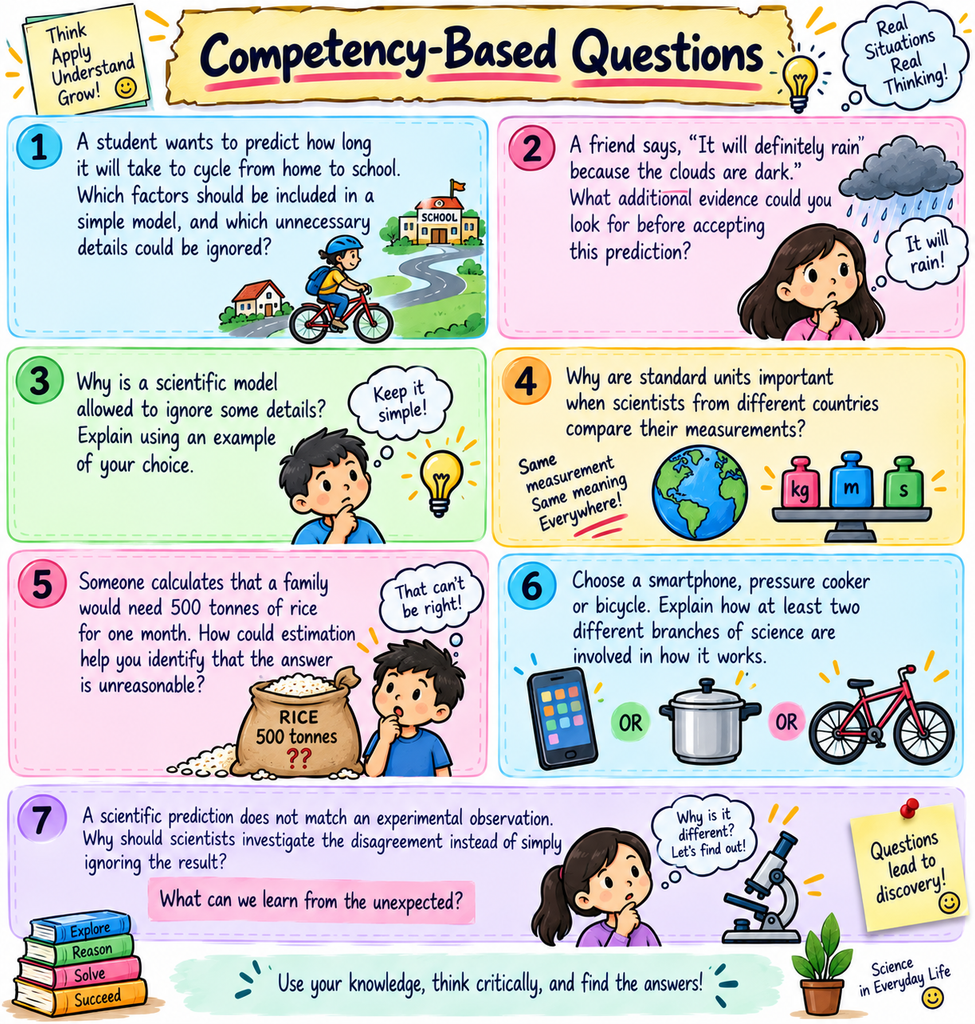
Competency-Based Questions
Conclusion
Science at the secondary stage is not just about learning more facts—it is about learning to think more deeply. Models help us simplify complex situations, precise language and standard units help us communicate clearly, mathematics helps us express relationships, and predictions and estimations help us use scientific knowledge in meaningful ways.
As you move through Class 9 Science, remember that understanding is more important than simply memorising. Ask questions, look for evidence, test ideas and stay curious. Every scientific exploration begins with the willingness to ask, “Why?” and “How do we know?”
Frequently asked questions
1. What is a scientific model?
A scientific model is a simplified representation of a real system. It focuses on the features that are important for answering a particular question.
2. Is a scientific theory just a guess?
No. In science, a theory is an evidence-based explanation that has been tested and critically examined. It is very different from the everyday use of the word “theory” to mean a guess.
3. Why does science use standard units?
Standard units allow measurements to be compared and communicated consistently. They reduce confusion and help avoid errors.
4. Is a prediction the same as a guess?
No. A scientific prediction is based on evidence, established knowledge, models or observed patterns. A guess may not have such a basis.
5. Why does science use estimation?
Estimation helps us decide whether an answer is reasonable. It can also help detect mistakes and develop a better understanding of quantities.
6. Why are different branches of science connected?
The natural world is interconnected. Real-world problems often involve several kinds of scientific knowledge, so physics, chemistry, biology, Earth science and mathematics may work together.